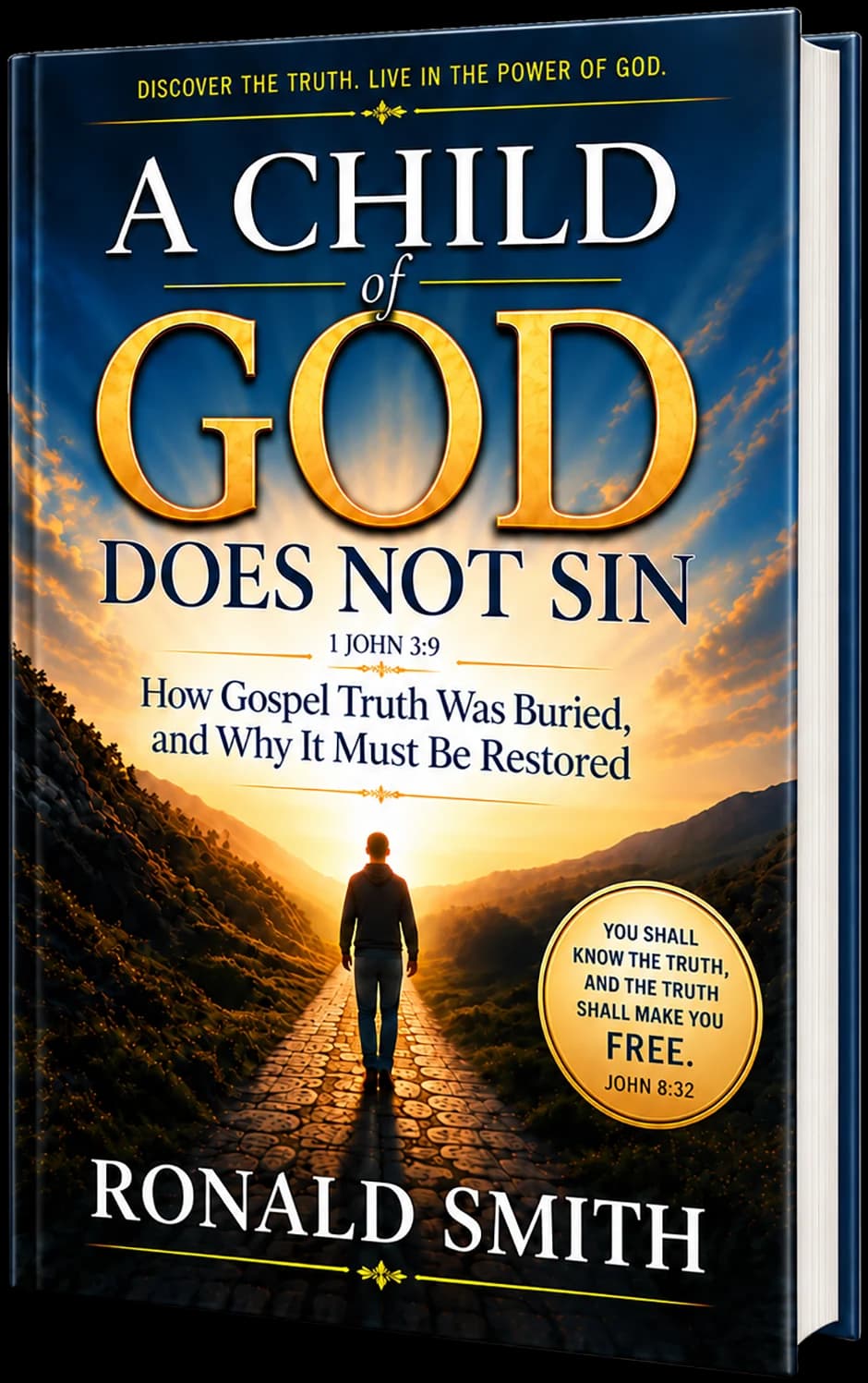

A long Facebook post has been making the rounds, arguing that free will is an illusion and the foundation of both pride and anxiety. It reads well, and it carries a real insight about people who try to run their own lives. Since my book, A Child of God Does Not Sin, rests on the idea that God gave us a real choice, I want to look at it fairly. I'll take my own premise as given, knowing some readers see it differently.
Where the post is right
The author describes a driven man who believed he was in charge of everything: his business, his marriage, his future. When it all fell apart, he found relief in trusting God instead of himself. I don't doubt that. Anyone who thinks the whole weight of life sits on his shoulders will be crushed by it. Jesus says, "without Me you can do nothing" (John 15:5), and Paul asks, "What do you have that you did not receive?" (1 Corinthians 4:7). I agree with both.
I also agree with the line that the fight is "to believe," not just to behave. In my book I call unbelief the root of all sin.
Knowing is not causing
The post argues that if God knows you will choose A tomorrow, you cannot choose B. But knowing is not the same as causing. John Wesley answered this in his sermon "On Predestination." God's "knowledge supposes our sin, but does not in anywise cause it," he wrote. And: "Men are as free in believing or not believing as if he did not know it at all." God sees every choice before it happens, and seeing is not forcing.
The Bible doesn't use the phrase, but it describes the thing
The post says Scripture has little to say about free will. The phrase isn't there, any more than "Trinity" is. What is there is real choice: "choose for yourselves this day whom you will serve" (Joshua 24:15). "I have set before you life and death... therefore choose life" (Deuteronomy 30:19).
Jesus says to some of His hearers, "you are not willing to come to Me that you may have life" (John 5:40). Over Jerusalem He grieves, "How often I wanted to gather your children together... but you were not willing!" (Matthew 23:37). Jesus wanted something, and a human will said no. That is hard to square with a world where God writes every choice.
"Command is not ability," and grace supplies it
This part of the post is half right. A fallen person cannot come to God by his own strength, and Wesley taught the same. But the answer is not that people have no will. It is that God gives help to everyone. Wesley called this prevenient grace, the grace that goes before us. Jesus says, "I, if I am lifted up from the earth, will draw all peoples to Myself" (John 12:32). That enabling grace is what makes a response possible.
The post leans on Philippians 2:13, "it is God who works in you both to will and to do for His good pleasure." Read the verse before it: "work out your own salvation with fear and trembling." John Wesley preached a whole sermon on these two verses. His point was that God's work and ours go together: "God works; therefore you can work," and "God works, therefore you must work."
What about Joseph and the cross?
The post's strongest examples are Joseph and the crucifixion. Joseph tells his brothers, "you meant evil against me; but God meant it for good" (Genesis 50:20). Notice that the brothers still meant evil. God did not need to cause their hatred to bring good out of it. In Acts 4:27-28, Herod and Pilate did "whatever Your hand and Your purpose determined before to be done." Yet Peter tells the crowd that Jesus was "delivered by the determined purpose and foreknowledge of God," and that "you have taken by lawless hands, have crucified, and put to death" (Acts 2:23). God's plan ran through their choices, and the text still holds them responsible.
The post also leans on Romans 9. I took that up in an earlier post, "Is Arminianism Unbiblical?"
Where it matters for sin
Here is why I care. The post says that Eve eating the fruit "was always the plan," and that God can direct even our sinful choices. If that is true, then calling a sin willful loses its footing. The person never could have done otherwise. A Reformed reader will say people are still responsible because they do what they want. But when Jesus says He wanted to gather Jerusalem and they were unwilling, two wills met, and His was not the one that won.
But Scripture says, "God cannot be tempted by evil, nor does He Himself tempt anyone" (James 1:13). It describes a heart that departs from God as a heart that chose to: "Beware, brethren, lest there be in any of you an evil heart of unbelief in departing from the living God" (Hebrews 3:12). And my book's central claim, that a child of God does not sin willfully, depends on a believer who can choose obedience and who can also choose to walk away.
The same goes for the closing advice to "put the decisions down." Joshua didn't say that. He said, "choose."
This is also why I read the "no one can snatch them" verses the way I do. John 10:28-29 and Romans 8 promise that no outside power can pull us from God's hand: "neither death nor life... nor any other created thing" (Romans 8:38-39). Some say "any other created thing" must include you. But Paul is answering a question about what can be done to us, not what we might do to ourselves. His question is, "Shall tribulation, or distress, or persecution...?" (Romans 8:35). The same chapter adds a condition: "if you live according to the flesh you will die; but if by the Spirit you put to death the deeds of the body, you will live" (Romans 8:13). In my book I put it this way: God is not the wildcard. We are.
What this isn't
This isn't a claim that we are the authors of our lives. We are not. Even the ability to choose is something we received, which is why Paul says salvation is "the gift of God, not of works, lest anyone should boast" (Ephesians 2:8-9). Pride is not choosing. Pride is forgetting where the choice came from.
Rest comes from trusting the One who holds our lives. It doesn't come from pretending we have no part in it.
A Child of God Does Not Sin is now available on Amazon.