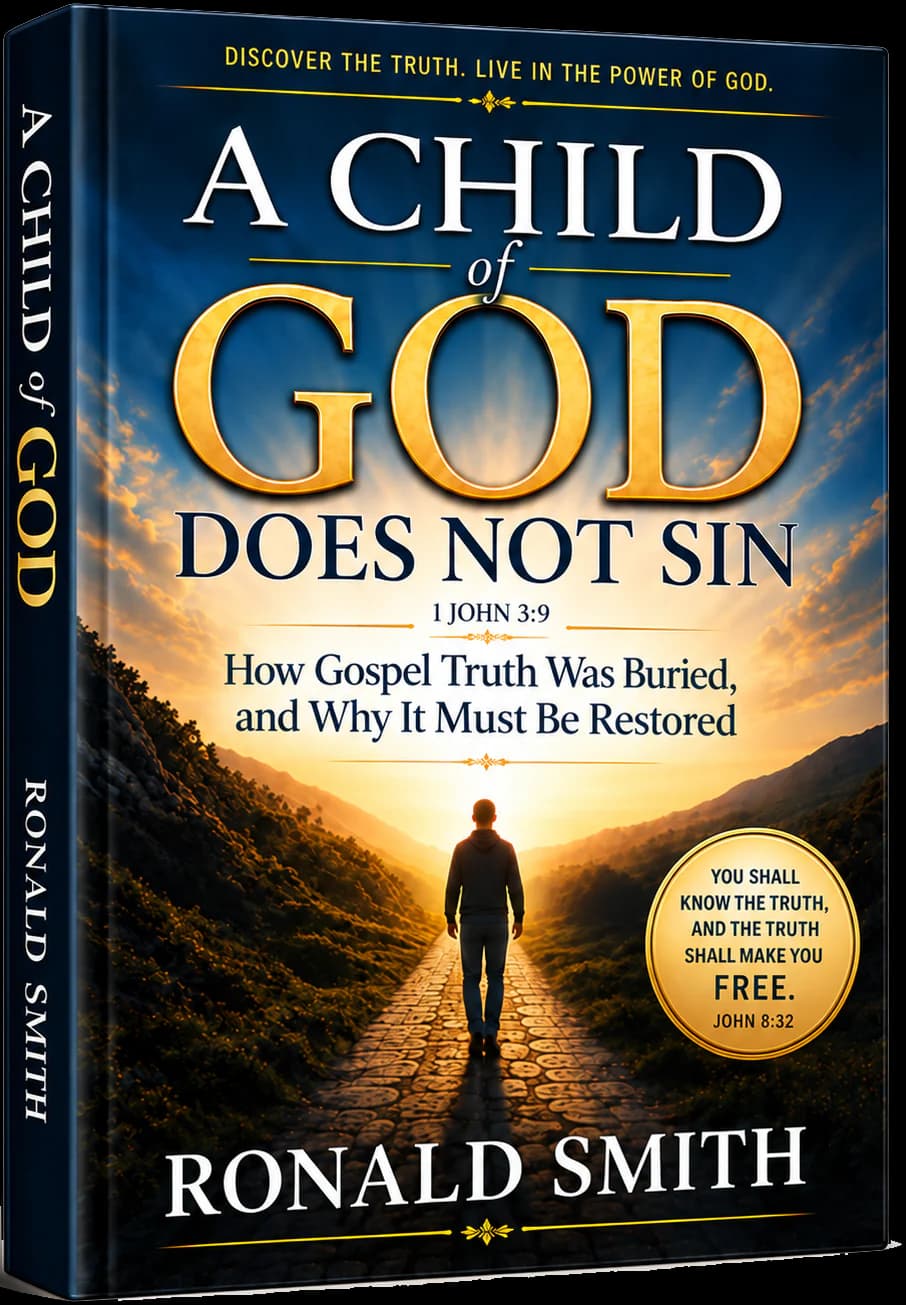
Welcome to the first post on this site. I’m Ronald Smith, author of A Child of God Does Not Sin — and I plan to use this space to think through questions that come up as I talk with people about the book. I’m not a pastor or a seminary grad; my background is 45 years in sales and marketing, plus a journalism degree from Northern Arizona University (NAU). What I bring to these questions is the same thing I bring to the book itself: a willingness to dig into Scripture directly and follow the argument wherever it goes.
I came across something online the other day that got me thinking, and it happens to land right in the middle of a question my book deals with. So consider this the first of what I hope will be a running conversation.
It was a preacher’s prayer for deliverance, and honestly, it was powerful. The passion in it was real. But then I caught that he was praying this way over “born-again believers” — people he considered already saved — and something clicked in my head. That didn’t sit right with what I’ve spent the last few years arguing in my book. So I did a little digging.
Turns out this wasn’t just some random guy — it was John Eckhardt, author of the widely used Deliverance and Spiritual Warfare Manual. Eckhardt has said plainly that he believes born-again, Spirit-filled believers can still have demons living in them. In a 2003 article, he described how his own church changed its teaching to match what they were seeing in practice:
“The problem was, our experience did not match our theology. When we ministered deliverance, we frequently prayed for people we knew were born-again, Spirit-filled believers — and they manifested demons. We had to face the fact that either our experience was wrong or our doctrine was wrong.”
He concluded the doctrine was wrong, not the experience. He now teaches that deliverance from demonic possession is something every new convert should go through, and says it bluntly — that the question isn’t whether a new believer has a demon, just how many.
To be fair to his side before I make mine
Before I go further, it’s worth saying plainly: Eckhardt’s own framework isn’t as crude as “born-again people are possessed, full stop.” Like most serious deliverance ministers, he distinguishes possession — ownership, full control — from what’s usually called demonization: oppression, affliction, a foothold in a specific area, still real but categorically different from a demon owning the house. A lot of the Pentecostal and Holiness tradition my own book draws on — the world of Azusa Street, of Kathryn Kuhlman — has never had a problem believing a genuine believer can be attacked, harassed, or given ground to the enemy through unaddressed sin or trauma. I don’t have a problem with that either. That’s not the claim I’m pushing back on.
What stopped me is the stronger claim — that a demon can be living in someone who is genuinely born again and filled with the Holy Spirit, as a matter of course, for every new convert. That’s a specific, answerable question: does the new birth, and the infilling of the Spirit that comes with it, actually push out whatever was there before — or can the two just sit there side by side?
My gut reaction: light and darkness
My first instinct, before I looked anything up, was pretty simple: light and darkness can’t occupy the same space. Turns out there’s a verse that says it even more directly than I first reached for. John writes plainly: “For this purpose the Son of God was manifested, that He might destroy the works of the devil” (1 John 3:8). Destroy — not manage, not negotiate a truce with. Jesus didn’t come to arrange a roommate situation between Himself and whatever else was already living there. Paul makes the same point from a different angle in 2 Corinthians 6:14 — “what fellowship has light with darkness?” — used there about believers linking arms with unbelievers, but the principle underneath it is the same: light doesn’t share the room. It empties it.
So if that’s true, the question becomes: were the people Eckhardt is describing actually walking in the light to begin with?
Digging a little deeper
The more I read, the more I kept landing on a distinction that’s apparently pretty old in church history — the difference between two kinds of “believing”:
- Believing facts about Jesus assensus — that he existed, that he died, that the Bible is true.
- Actually trusting in him fiducia — the real, heart-level reliance that Scripture calls saving faith.
It turns out the Greek text itself draws this exact line. James makes the point that even demons “believe — and shudder” (James 2:19) — and the actual Greek there is pisteueis hoti, “you believe that” God is one. That’s the grammar of agreeing a fact is true. John’s Gospel, on the other hand, keeps reaching for a different construction — pisteuō eis, “believe into” — not assent to a proposition, but a person entrusting themselves into someone else (John 3:16 is the most famous example). Same root verb, two different kinds of believing, and the New Testament’s own wording tells you which one the demons have. Just believing facts clearly isn’t enough, or demons would qualify.
And there’s a passage that stopped me cold once I found it — Jesus himself, in Matthew 7:21–23, talking about people who did the exact kind of thing Eckhardt’s tradition points to as proof of being Spirit-filled:
“Many will say to me in that day, ‘Lord, Lord, have we not prophesied in your name, cast out demons in your name, and done many wonders in your name?’ And then I will declare to them, ‘I never knew you; depart from me, you who practice lawlessness.’”
Jesus isn’t telling these people they lost their salvation. He tells them he never knew them. And the thing they’re pointing to as proof — casting out demons, no less, in his own name — he says doesn’t count. That’s the exact category of evidence I saw in that online video that first caught my attention.
The three verses I had to deal with, not avoid
I’d be dodging if I didn’t also engage the strongest cases deliverance teachers actually reach for, because two of them turn out to answer themselves once you check the calendar.
Jesus rebuking Peter — “get behind me, Satan” — for resisting the cross (Matthew 16:23). Judas, included among the Twelve and sent out with authority to cast out demons in Jesus’s own name (Matthew 10:1). Both of these happen before Pentecost — before the Holy Spirit had come to permanently indwell anyone. That’s not a minor detail; it’s the whole hinge of my book. Before Acts 2, the Spirit came upon people, temporarily, for a task. After Acts 2, the Spirit comes in, permanently. Peter and Judas are both operating under the old system. Whatever was true of them in that moment tells you next to nothing about what’s possible inside someone who is actually, permanently indwelt — because that reality didn’t exist yet for either of them. Pre-Pentecost examples are pretty much useless as evidence for a post-Pentecost question. Everyone seems to forget Pentecost happened. It’s amazing.
That leaves the one example that’s genuinely post-Pentecost: Satan “filled” Ananias’s heart to lie to the Holy Spirit (Acts 5:3), a believer in the early church, after the Spirit had come. But look at what actually happens next. Ananias isn’t prayed over for deliverance — he’s struck dead on the spot, a specific act of deception judged directly and immediately by God, not treated as a man with a foreign tenant that needed evicting over time. That’s a different category than an indwelling presence requiring ongoing ministry to remove. It’s sin, met head-on, in the moment it happened.
So here’s where I landed, with all due respect to Apostle Eckhardt — that’s the title he goes by in his own ministry: in my opinion, the people in these deliverance cases likely weren’t genuinely born-again believers who somehow still had a demon living in them. They may have been sincere, they may have prayed a prayer or spoken in tongues or felt something real — but sincerity and feeling something isn’t the same as true saving faith. I write about this distinction extensively in my book, A Child of God Does Not Sin — the difference between a real, settled new birth and the kind of profession or experience that can look like one without actually being one.
My own doctrine changed too — just in the other direction
Here’s something I didn’t expect to find myself saying: Eckhardt and I actually did the same thing. He let his experience correct his doctrine, and said so plainly — “our experience did not match our theology… we had to face the fact that either our experience was wrong or our doctrine was wrong.” I respect that. It’s honest, and it’s the right instinct.
My own doctrine changed the same way. Just in the opposite direction.
I spent years inside a half-gospel — forgiveness offered, transformation not really expected, “nobody’s perfect” doing the work that real repentance was supposed to do. And for a long time, my experience matched that theology just fine, because I never really tested it against anything bigger. Then I didn’t buy it anymore. And when I actually believed the whole gospel — not just the pardon, but the power — I watched it produce something my old theology had no explanation for: real, visible, sustained transformation. In my own life first. Then in people I watched up close.
My brother Daniel is the clearest example I have. Daniel spent years in the grip of addiction — homelessness, jail, a marriage that didn’t survive it, the whole ugly list. We tried everything a family tries. Nothing stuck, because nothing we offered him was the whole thing. Then in 2019, I finally sat down with him and gave him the whole gospel, not the half-gospel version, and told him the truth about what it can actually do to a life. He was ready. It didn’t take long. His life did a complete 180 — and I mean that literally, not as a figure of speech. He quietly stopped answering to “Dan.” Told me flat out that Dan didn’t exist anymore. He spent his last years living out of a van, and when I sent him Charlie Daniels’ gospel album The Door, he played it every single day until he died in 2022. His last self-description, on his own Facebook page, was: A Follower of Jesus of Nazareth.
I didn’t watch a man get a little better. I watched a new creation happen in real time, the way 2 Corinthians 5:17 describes it — not a renovation, a replacement. That’s the experience that reshaped my theology, the same way Eckhardt’s reshaped his. His pointed him toward believers needing ongoing deliverance from what’s still living in them. Mine pointed me toward what actually happens when someone stops managing sin and starts being free of it.
I’m not writing this to take shots at Eckhardt or the deliverance ministry world — there’s plenty in Scripture about real spiritual warfare, and I don’t doubt his sincerity any more than I’d want him to doubt mine. But I’ve come to see the power of the whole gospel at work in people who truly “get it,” and in that person, there is no space left for a demon to live. That said, this is the kind of question I plan to keep working through on this site as it comes up, and I’d rather do that thinking in the open than pretend I arrived at every answer in one sitting.
I write about this distinction — the difference between believing facts and actually trusting, and what genuine new birth after Pentecost really does to a person — at much greater length in my book. A Child of God Does Not Sin releases on Amazon October 1, 2026.