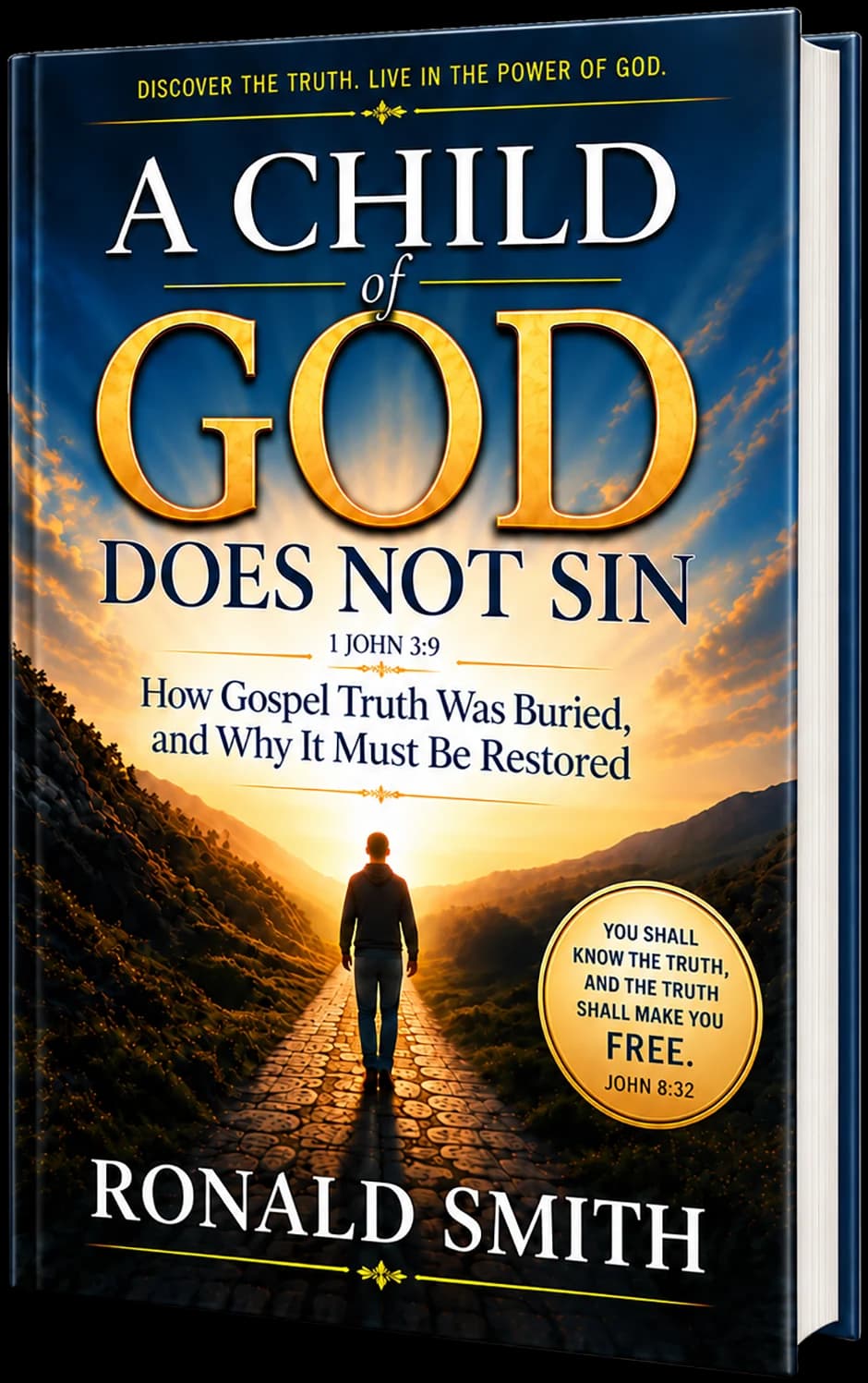

I was listening to a reel the other day where a guy took aim at a phrase, "getting closer to God." His point was that the phrase is built on a fallacy. It pictures a sliding scale, with God at one end and you somewhere along the line, inching forward in your relationship with Him. He's right. Scripture doesn't talk that way. John 15 is all about abiding, and you either abide or you don't. That lands squarely on the ground my book, A Child of God Does Not Sin, is built on, because the biggest fallacy out there is that being "close" to God is the standard.
And yes, you can get "closer" to deciding to surrender to God. Look at King Agrippa, who "almost" became a Christian (Acts 26:28). But the standard for a born-again Christian is "abide," not "close."
The argument against "closer"
In John 15, Jesus gives His clearest picture of what the relationship between Him and His followers actually is, and the word He builds it on isn't "near." It's "abide." The Greek is menō: to remain, to stay, to dwell. "Abide in Me, and I in you. As the branch cannot bear fruit of itself, unless it abides in the vine, neither can you, unless you abide in Me" (John 15:4).
Think about what that picture does and doesn't allow. A branch is attached to the vine or it isn't. There's no such thing as a branch that is "closer" to the vine than the one next to it. A branch an inch from the trunk but cut off is every bit as dead as one lying across the yard. And Jesus doesn't soften the other side of it: "If anyone does not abide in Me, he is cast out as a branch and is withered; and they gather them and throw them into the fire, and they are burned" (John 15:6). Nobody in that verse is described as "not close enough." They're described as not abiding.
What's wrong with the sliding scale
A sliding scale quietly turns a relationship into a progress bar, and a progress bar lets you feel fine at sixty percent. That's the real danger in the phrase. It makes "closer than I was" feel like an answer to a question Jesus never asked.
I make the same point in the book with an analogy that makes people wince: some things can't be done partially. You can't be almost pregnant. You either are or you aren't. Chapter Sixteen applies that to the idea of being "almost saved," and Chapter Eighteen applies it to following Jesus: you cannot "mostly" follow Him, and you cannot "usually" obey. Chapter Four is built on this same vine and branches passage, and its point is the same one: the life flows from the connection, not from the effort. It's a life of staying, not straining.
The verse people reach for
To be fair to those who defend the "closer" language, there is a verse that uses nearness language, and it's a command: "Draw near to God and He will draw near to you" (James 4:8). The Greek there is engizō, a word for approaching, and it's not the word John 15 is built on. If "getting closer to God" were a pure fallacy, James has some explaining to do.
But read the rest of the verse. "Cleanse your hands, you sinners; and purify your hearts, you double-minded." What does drawing near actually consist of? Not putting more hours on a gauge. It's a turn: wash your hands, purify your heart, stop trying to hold on to both sides. Double-minded isn't a degree of closeness. It's a split. I read James 4:8 as a call to repentance, and repentance is a turn, not a sliding scale. It's the move from outside the vine back onto it.
What can grow
None of this means a believer stays frozen. The same chapter says so: "Every branch in Me that does not bear fruit He takes away; and every branch that bears fruit He prunes, that it may bear more fruit" (John 15:2). Same branch, more fruit. Attachment is yes or no. Fruitfulness grows.
Paul is the best example. He wrote that he wanted to "be found in Him" (Philippians 3:9), and in the very next verse, "that I may know Him" (3:10). He was already in Christ, and he was still pressing to know Him better. So yes, you can think about God, talk with God, and hear from God more consistently than you did yesterday. Nothing here argues against that. Depth of fellowship and amount of fruit are real, and they grow. They just aren't the same question as whether you're attached.
The line that doesn't move
Willful sin is the dividing line. Each time it comes up, it's a yes or a no. You knew it was wrong, and either you chose it or you didn't. There's no partial credit for willfully disobeying a little less often. It's a matter of your will, not your mood or your calendar of devotions.
Jesus ties abiding to exactly that line: "If you keep My commandments, you will abide in My love" (John 15:10). John does the same in his letter: "Whoever abides in Him does not sin" (1 John 3:6), and "He who says he abides in Him ought himself also to walk just as He walked" (1 John 2:6). Abiding isn't a feeling of nearness. It has a moral shape. But the shape isn't only what you avoid. It's the love Jesus puts at the center of the same chapter: "abide in My love" (John 15:9). Obedience is how that love shows up, not a substitute for it.
To be clear about what that means and doesn't mean: this was never a claim that a believer will never make a mistake. Mistakes, ignorance, temptation, and ordinary human infirmity aren't what's in view. This is about willful, deliberate sin specifically, which is exactly the kind a person can see clearly and decide whether to choose.
Horseshoes and hand grenades
Chapter Ten of my book puts it bluntly: heaven is not like horseshoes and hand grenades. Close does not score points. The same is true of this life. "Close to God" is a mile away when it comes right down to it, because the question was never how close. In Matthew 7:23, Jesus turns away people who called Him Lord and did works in His name, and His answer isn't "you weren't close enough." It's "I never knew you; depart from Me, you who practice lawlessness." Being known by Him was the measure, not nearness.
You either abide in Him, or you don't. All or nothing. The sliding scale is the part of the old phrase worth throwing out. The part worth keeping is the daily turning toward Him, every time the choice comes up.
A Child of God Does Not Sin is now available on Amazon.