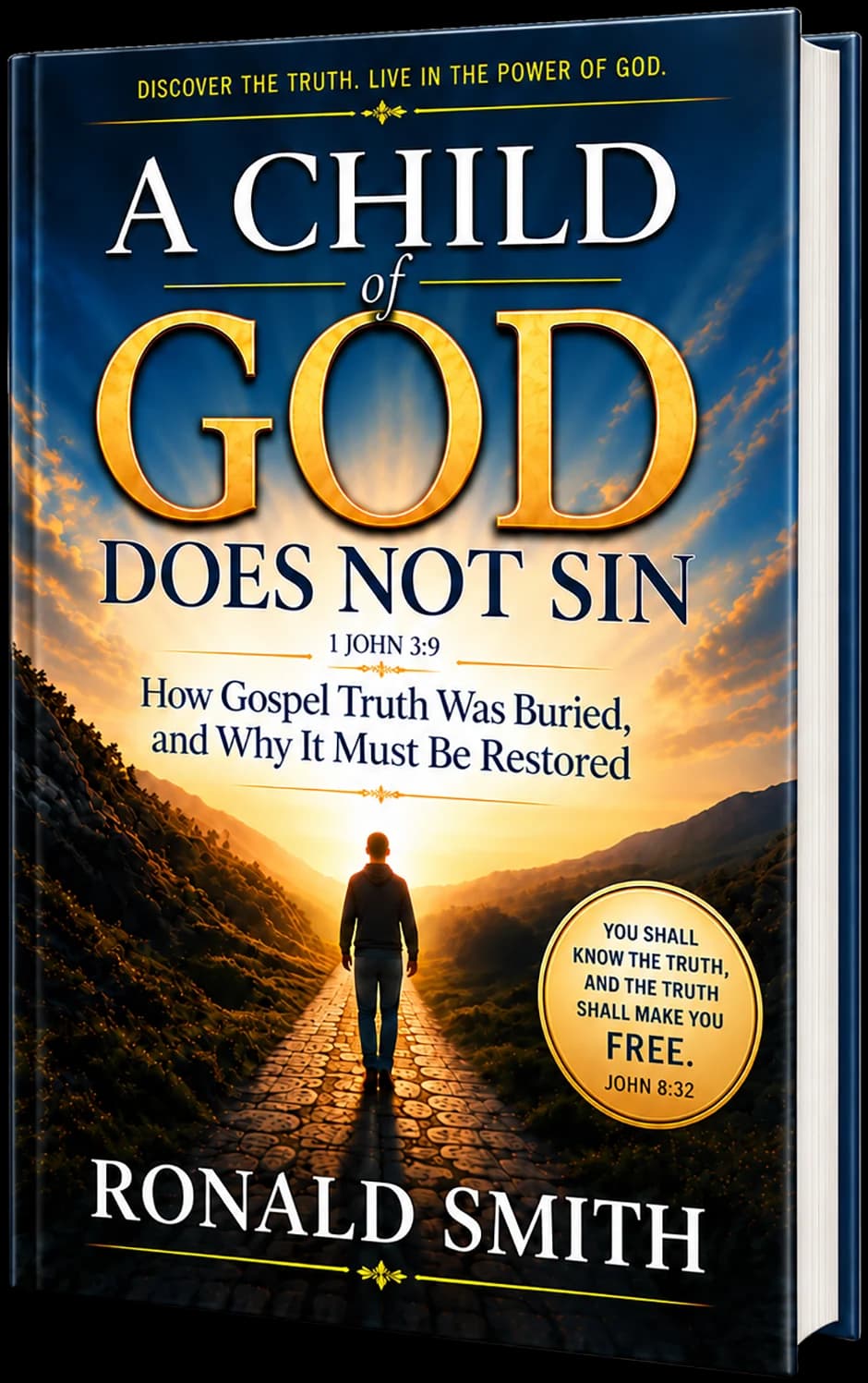

An infographic has been making the rounds under the headline "Why Arminianism Is Unbiblical," with six numbered reasons, each backed by a verse. It's a one-sided piece, but it's confident, polished, and shared by people who mean it, so it deserves a real answer. I'm not going to reproduce it, since it's someone else's work. I'll summarize each of the six claims and answer them. This is also ground my book, A Child of God Does Not Sin, covers, especially in Chapter Eleven, "Two Rivers, One Church," where I lay out both traditions side by side.
Where I agree with it
The closing line of the infographic is "Salvation is of the Lord," and I'd sign my name to it. Psalm 115:1 ("Not unto us, O LORD, not unto us, but to Your name give glory") and Romans 11:36 are not Calvinist property. Wesleyans sing them too. Ephesians 2:1 is also right: we were dead in trespasses and sins. And John 10:28 gives real assurance. Nobody can snatch a believer out of Christ's hand.
The framework behind the graphic, the "five points of Calvinism," grew out of the Synod of Dort's 1618-19 answer to the Remonstrants, a group of Dutch followers of Jacobus Arminius. So we are not arguing about whether grace matters. We're arguing about how it works.
Election and depravity (claims 1 and 2)
Claim 1 says Arminianism makes election conditional. The verse offered is Ephesians 1:4, which says God "chose us in Him before the foundation of the world." Arminians read that as election in Christ: the chosen are those who are in Him. Other verses point the same way: Peter writes to those "elect according to the foreknowledge of God the Father... for obedience" (1 Peter 1:2), and Paul says God chose the Thessalonians "for salvation through sanctification by the Spirit and belief in the truth" (2 Thessalonians 2:13). Neither one says election is unconditional. Reformed readers take "foreknew" in Romans 8:29 to mean God set His love on people beforehand, not that He foresaw their faith. That's a real argument, and these verses alone don't end it. What they do show is that election in Scripture is tied to being in Christ, to sanctification, and to belief.
Claim 2 says Arminianism "minimizes total depravity." That's the weakest panel as a description of Arminianism. The Remonstrants of 1610 wrote that fallen man "can of and by himself neither think, will, nor do any thing that is truly good." John Wesley preached the same thing in his sermon on original sin: fallen humanity is empty of all good and filled with evil. The disagreement is not whether we are helpless. It's whether God's grace comes first and enables a response to everyone, which is what Wesleyans call prevenient grace ("I... will draw all peoples to Myself," John 12:32; "the grace of God that brings salvation has appeared to all men," Titus 2:11). The view the panel describes, that man can save himself by his own ability, is Pelagianism, and Arminians reject it too.
What about Romans 9?
Every Calvinist conversation lands here sooner or later, and it deserves a fair look. Paul writes, "I will have mercy on whomever I will have mercy... it is not of him who wills, nor of him who runs, but of God who shows mercy" (Romans 9:15-16). Wesleyans say Amen. Salvation is mercy, and no one earns it by willing or running. But read to the end of the chapter and Paul tells us why Israel missed what the Gentiles received: "Because they did not seek it by faith" (9:32). Faith is the line he draws. Then he quotes God's own words about the people who missed it: "All day long I have stretched out My hands to a disobedient and contrary people" (10:21). Hands stretched out all day don't describe a God who wanted only some of them to come. And Paul warns the Gentile believers in the same section: "toward you, goodness, if you continue in His goodness. Otherwise you also will be cut off" (11:22). Reformed readers have careful answers to each of these, and the strongest part of Romans 9 is still ahead: Pharaoh and the potter. Here is a short answer to each.
- Pharaoh (9:17-18). "Whom He wills He hardens" is in the text. But Exodus gives the order: "he hardened his heart and did not heed them" (Exodus 8:15) comes well before "the Lord hardened the heart of Pharaoh" (Exodus 9:12). God hardens a man who has already hardened himself.
- The potter (9:19-23). "Does not the potter have power over the clay?" is the verse infographics love. But Paul is borrowing the picture from Jeremiah 18, and there the potter is not arbitrary. God says, "O house of Israel, can I not do with you as this potter?" (Jeremiah 18:6), and then explains how it works: if "that nation against whom I have spoken turns from its evil," He relents (18:8). The potter reshapes the clay in response to repentance. In Romans 9:22-23 the vessels of mercy are ones God "prepared beforehand for glory," while the vessels of wrath are simply "prepared for destruction," in a form that doesn't say who did the preparing. Reformed readers reply that the passive points back to God. That is a fair reading, but it is an inference and not what the verb says. And God "endured with much longsuffering" those vessels of wrath, which is a strange way to describe a God who made them for destruction.
So Romans 9 gives us a God who is sovereign over mercy, and it doesn't give us a God who withholds an offer. A chapter also can't be used to cancel the two that follow it.
Is grace resistible? (claims 3 and 4)
The graphic cites John 6:37: "All that the Father gives Me will come to Me." That's a promise about those the Father gives. It doesn't say grace can't be refused. The stronger Reformed verse is John 6:44: "No one can come to Me unless the Father who sent Me draws him; and I will raise him up at the last day." Reformed readers take that to mean everyone who is drawn is raised, so the drawing always works. But Jesus uses the same Greek word in John 12:32: "I... will draw all peoples to Myself." If drawing always succeeds, that verse would mean everyone is saved, which neither side believes. Arminians read it as grace that comes to everyone and can be refused. Reformed readers answer that "all peoples" means people from every nation, not every individual, and that is a serious reading, though "draw" still has to mean something there. Scripture also speaks as if grace can be refused: "You always resist the Holy Spirit" (Acts 7:51), and Jesus says over Jerusalem, "How often I wanted to gather your children together... but you were not willing!" (Matthew 23:37).
The panel on irresistible grace quotes Ezekiel 36:26, the new heart, and stops. Verse 27 is the next line: "I will put My Spirit within you and cause you to walk in My statutes, and you will keep My judgments and do them." Galatians 3:14 tells us we "receive the promise of the Spirit through faith." So the promise is received by faith, and its purpose is obedience. That is the heart of my book, and it's an odd verse to use against anyone who takes holiness seriously.
Can a believer fall? (claim 5)
The fifth panel quotes Romans 8:30 and John 10:28. Both are great news, and Arminians believe both. Romans 8:35-39 says nothing outside us can separate us from Christ's love. The question is whether a believer can walk away on their own. The same Bible that says "no one can snatch them out of My hand" also warns, "Beware, brethren, lest there be in any of you an evil heart of unbelief in departing from the living God" (Hebrews 3:12). The panel also leaves out the verse just before it: "My sheep hear My voice, and I know them, and they follow Me" (verse 27). Those are ongoing verbs. And it doesn't address "you have fallen from grace" (Galatians 5:4) or "if indeed you continue in the faith" (Colossians 1:23).
It's worth knowing that Arminians themselves were cautious about this. The original 1610 Remonstrance said the question needed to be "more particularly determined out of the Holy Scriptures" before they could teach it with full confidence. By 1618 they had concluded that believers can fall, and Wesley taught the same. My own view, laid out in Chapter Thirteen, is that eternal security is God's design: once you are saved, the plan is that you remain saved. What I reject is the claim that you are saved no matter what you do afterward. To be fair, Reformed perseverance is not the same as the "saved no matter what you do" version some people preach. The Reformed doctrine says true believers will persevere in faith and holiness, and that anyone who finally falls away was never truly His. That's a serious position, and my disagreement with it is narrower than my disagreement with the "no matter what" version. And to be clear, "falling" here means the deliberate, willful turning away that Hebrews 6 and 10 describe, not a stumble. Mistakes, ignorance, temptation, and ordinary infirmity aren't what's in view.
Who gets the glory? (claim 6)
The last panel says Arminianism "gives man the glory" by making salvation partly dependent on human decision. But receiving a gift is not earning it. Picture a man too weak to save himself, who is given the strength to take hold of a rope. He doesn't boast about his grip, because the strength was a gift too. Paul says it plainly: "By grace you have been saved through faith, and that not of yourselves; it is the gift of God, not of works, lest anyone should boast" (Ephesians 2:8-9). Wesley's first standard sermon is "Salvation by Faith," and in "Free Grace" he says God's grace "does not depend on any power or merit in man; no, not in any degree, neither in whole, nor in part." Free in all, and free for all, as he put it. And Philippians 2:12-13 puts both halves together: "work out your own salvation with fear and trembling; for it is God who works in you both to will and to do for His good pleasure." The glory stays where it belongs.
One question for both sides
Serious, godly people hold the infographic's view, and the best Reformed teachers, like Owen, Murray, and Lloyd-Jones, teach Spirit-produced holiness more richly than any comparison chart can show. So I'd ask a question that doesn't divide us: whatever you believe about election, grace, and perseverance, what does God's grace actually produce in a believer's life? If the answer is a heart that is changed and a life that walks in His statutes, then we are closer than the headline suggests, even though real differences remain. If the answer is only forgiveness, then something is missing from the gospel.
A Child of God Does Not Sin is now available on Amazon.