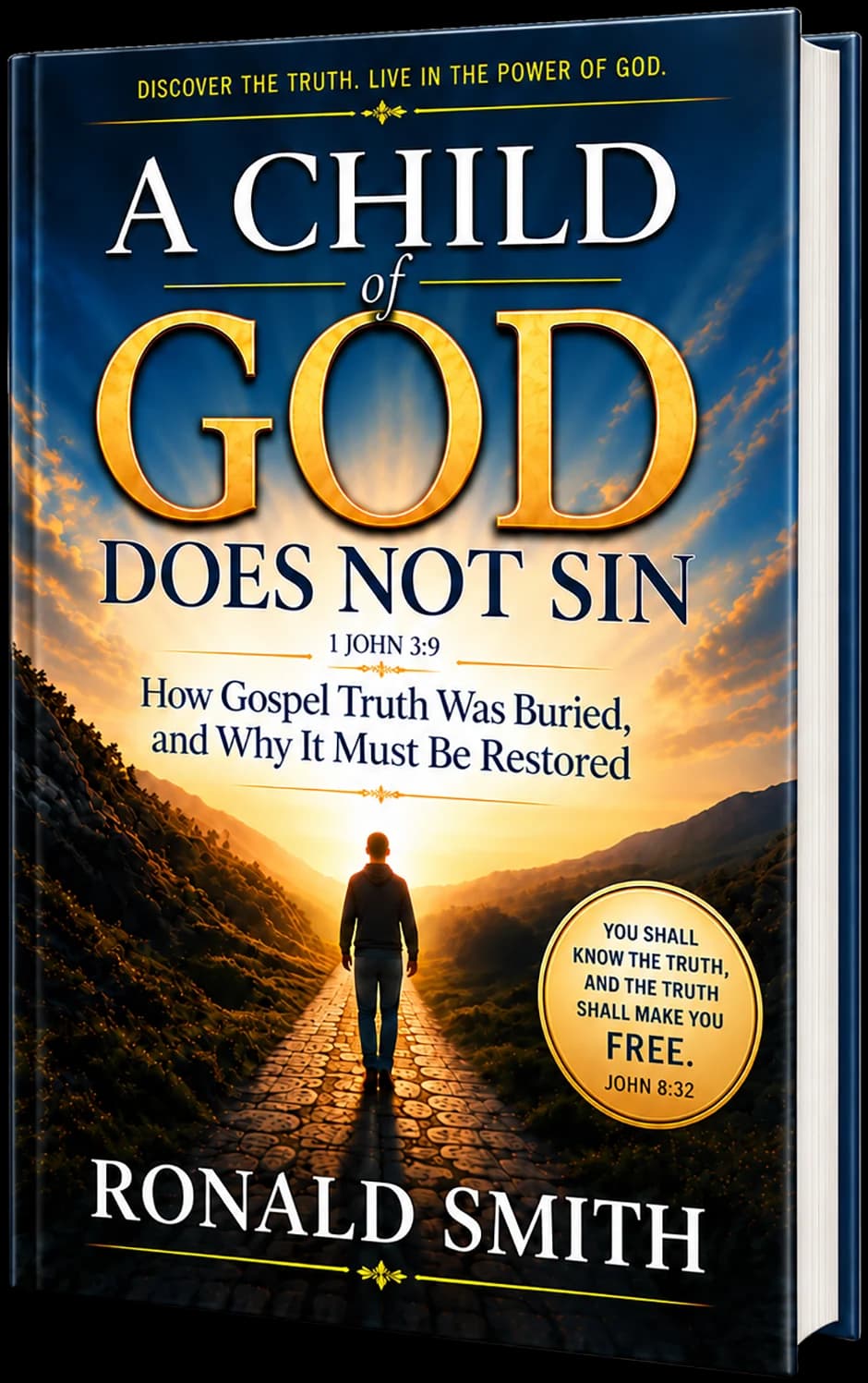

Few debates in Christianity have burned more hours than this one: can a genuine believer lose their salvation? I've spent a good part of my book, A Child of God Does Not Sin, on that argument, and Chapter Thirteen takes it on directly. But the longer I work on it, the more convinced I am that the debate itself misses the mark completely. The real issue is much simpler: why would anyone want to disobey Him in the first place?
First, a definition
Before anyone argues about whether sin can cost you your salvation, it matters which sin we mean. John Wesley, whose doctrine my book draws on, drew a line that most of the modern debate skips. Sin "properly so called" is a voluntary transgression of a known law of God. Everything else falls outside that definition: honest mistakes, genuine ignorance, temptations your will never agreed to, and the ordinary infirmities of a body and mind still touched by the fall.
"Voluntary" is Wesley's word. "Willful" is the Bible's. Hebrews 10:26 says it directly: "For if we sin willfully after we have received the knowledge of the truth, there no longer remains a sacrifice for sins, but a certain fearful expectation of judgment, and fiery indignation which will devour the adversaries." The Greek adverb is hekousiōs: voluntarily, by choice, of one's own accord. Not a stumble. Not a slip. A decision, made with the knowledge of the truth.
To be precise, the passage goes on in verse 29 to describe someone who has "trampled the Son of God underfoot," the most extreme form of that choice. I'm not claiming every willful sin is that. I'm pointing to the word itself: it is Scripture's own word for sinning by choice, as opposed to sinning by accident.
Notice what that does to the debate. Set aside the mistakes, the ignorance, the temptations never consented to, and the infirmities, and what's left is one narrow category: knowing it's wrong, and doing it anyway. That is the only category that ever raised the "Once Saved, Always Saved" question in the first place.
The question nobody asks
Once the definition is clear, the crowd that supports OSAS has to answer a simple question: why would this ever be an issue? Under what circumstances would a child of God disobey Him when:
- he clearly knows what he's supposed to do,
- God has equipped him with the Holy Spirit to do it, and
- he fully understands the consequences of not doing it?
Think about someone asking, "If I rob a bank and get caught, am I going to prison?" It's a fair question, and it has a clear answer. It's also the wrong question, because the better course of action is to not rob the bank in the first place. "Can I willfully sin and still be saved?" is the same question aimed at God. It only matters to someone for whom the robbery is already on the table.
That's why I don't think we should have to debate whether OSAS is sound theology. As it's commonly preached, it isn't, and the book makes that case at length. But the deeper point is that the problem it tries to solve should never be a live question for a born-again believer.
"But some things are just too tempting"
That's the usual answer, and it deserves a straight reply. If some temptations are simply too strong to refuse, then someone has to explain this verse: "No temptation has overtaken you except such as is common to man; but God is faithful, who will not allow you to be tempted beyond what you are able, but with the temptation will also make the way of escape, that you may be able to bear it" (1 Corinthians 10:13).
Do you believe that verse? If you do, "too tempting" is off the table. God has promised that no temptation will exceed what you can bear, and that there is always a way out. And it isn't the only promise of its kind:
- "I will put My Spirit within you and cause you to walk in My statutes, and you will keep My judgments and do them" (Ezekiel 36:27).
- "His divine power has given to us all things that pertain to life and godliness" (2 Peter 1:3).
- "Now to Him who is able to keep you from stumbling, and to present you faultless before the presence of His glory with exceeding joy" (Jude 24).
Either those promises apply to the believer or they don't. If they do, then the explanation for willful disobedience can't be "I couldn't help it." If they don't, someone needs to explain what the New Covenant actually added.
What Jesus said about obeying Him
That leaves one excuse standing: "I didn't want to." So consider what Jesus Himself said about obeying Him. Chapter Three of the book lists ten statements like this from Jesus and the apostles. These are five of the clearest, all from Jesus:
- "If you love Me, keep My commandments" (John 14:15).
- "If anyone loves Me, he will keep My word; and My Father will love him, and We will come to him and make Our home with him. He who does not love Me does not keep My words" (John 14:23-24).
- "If you keep My commandments, you will abide in My love" (John 15:10).
- "You are My friends if you do whatever I command you" (John 15:14).
- "Most assuredly, I say to you, if anyone keeps My word he shall never see death" (John 8:51).
Notice what He doesn't say. He doesn't say "if you love Me, try to keep My commandments," or "keep most of them." He ties obedience to love, to abiding, to friendship, even to life itself, over and over, and the book calls these what they are: real conditions, stated plainly as conditions, by Jesus Himself. Which brings the question back around. If you love Him, and you know what He asked, and He has given you everything you need to do it, what exactly is the reason to disobey?
What I'm not arguing against
Let me be clear about what I'm not pushing back on. Eternal security is God's design. Chapter Thirteen says so plainly: His intent is that once you are saved, you remain saved. What I'm pushing back on is the version that says you stay saved no matter what you do afterward, including knowingly and deliberately disobeying Him. That version takes the "if" out of a promise that has always had one, and it's the only reason the question above ever sounded like a debate instead of an absurdity.
I know the usual objections, Romans 7 and 1 John 1:8 chief among them. They're real passages, and I work through both in the book rather than step around them. Others point to the man in 1 Corinthians 5, handed over to Satan "that his spirit may be saved in the day of the Lord Jesus" (1 Corinthians 5:5). Notice that it's a rescue operation with a goal. Nobody is disciplined that severely if nothing is at stake, and the hope is that he turns.
And if you're reading this because you did something you knew was wrong and you're afraid, you are not who this post is aimed at. The way back is open, and Chapter Fifteen is about exactly that. And the fear itself isn't the last word: "The Spirit Himself bears witness with our spirit that we are children of God" (Romans 8:16). That assurance comes from Him, not from a theory.
Where the argument belongs
This is why I keep returning to the idea Wesley called Christian Perfection. It isn't sinless perfection, a phrase he refused to use (I wrote about that in an earlier post). It is a heart so filled with love for God that willful disobedience is no longer what it wants. And the standard that follows from it is one the world already understands: zero tolerance.
You wouldn't tell your wife on your anniversary that you were ninety percent faithful. Nobody hears "mostly faithful" as good news. Zero tolerance for willful sin isn't harsh. It's the only standard that fits the verses above.
To be clear, this was never a claim about moral perfection. Mistakes, ignorance, temptation, and ordinary human infirmity aren't what's in view. This is about willful, deliberate sin specifically.
That is where the OSAS argument belongs: shut down at the point where the question stops making sense. Not by winning the debate, but by making it unnecessary.
A Child of God Does Not Sin is now available on Amazon.