
Landing on a symbol for the book turned out to be harder than I expected. It's not easy to illustrate an idea. Every option kept defaulting to the same place — something pointing up toward heaven, since that's the goal of every believer. The cross, the empty tomb, a sunrise breaking the dark. All of it points to the resurrection, and for good reason — the resurrection had to happen for what came next to happen at all. But once I noticed the pattern, I didn't want to just repeat it. I wanted a symbol that pointed toward the part of the story almost nobody puts on a logo: not Christ going up, but what He sent back down.
Or as five-time Grammy Award-winning Christian singer/songwriter Steven Curtis Chapman puts it, "Heaven in the Real World."
The mark at the top of this post is a dove descending into a sunrise — not a random choice of bird, but the same image Matthew reaches for at Jesus's own baptism: "He saw the Spirit of God descending like a dove and alighting upon Him" (Matthew 3:16, NKJV). Scripture already handed us the picture.
Here's the theology behind that choice, and it turns out to be worth a post on its own.
The verse that gets skipped
Jesus tells His disciples something that should stop anyone reading it carefully: "It is to your advantage that I go away; for if I do not go away, the Helper will not come to you; but if I depart, I will send Him to you" (John 16:7, NKJV). This isn't Jesus resigning Himself to something regrettable, or offering a diplomatic "it's for the best." The Greek word behind "advantage" is sympherei — genuinely profitable, advantageous, beneficial. Not merely tolerable. Jesus wasn't announcing a loss His disciples would have to accept. He was announcing an upgrade.
Why leaving was actually the better deal
Here's the part that's easy to miss: Jesus in a physical body could only be in one place at a time. He could walk with His disciples in Galilee, but He could not, at that same moment, be with anyone in Jerusalem. Wherever He wasn't, He was simply absent — a real, physical limitation built into having one body in one location. What He was sending had no such limitation.
Jesus says as much Himself, plainly, before He ever leaves: "the works that I do he will do also; and greater works than these he will do, because I go to My Father" (John 14:12, NKJV). Greater works, tied explicitly to His going. Not despite the absence. Because of it.
A heavenly defense attorney who never leaves
Jesus uses a specific word for what's coming: parakletos — a legal term in the Greek of His day, describing someone called alongside another person to speak on their behalf when they couldn't speak for themselves. An advocate. Defense counsel who shows up and never leaves the room. That's the word behind "Helper." Not a symbol. Not a metaphor. A named legal role, assigned to the Holy Spirit specifically.
And unlike Jesus in a body, the Spirit has no location to be confined to. He can't be absent from anywhere, because presence isn't the kind of thing that limits Him the way a body does. Fully present with every believer, simultaneously, everywhere, all at once, without restriction.
The disciples had less than you do
Which means something most people have exactly backwards. Every person who's ever wished they could have walked with Jesus in Galilee, watched Him heal someone, heard Him teach in person — that instinct has the math upside down. The disciples who walked beside Him physically had less access to His presence than a believer has right now. They had Him in the room they happened to be standing in. You have the unlimited version: everywhere, always, already inside you.
Not ascension. Arrival — and then presence, spreading out from there.
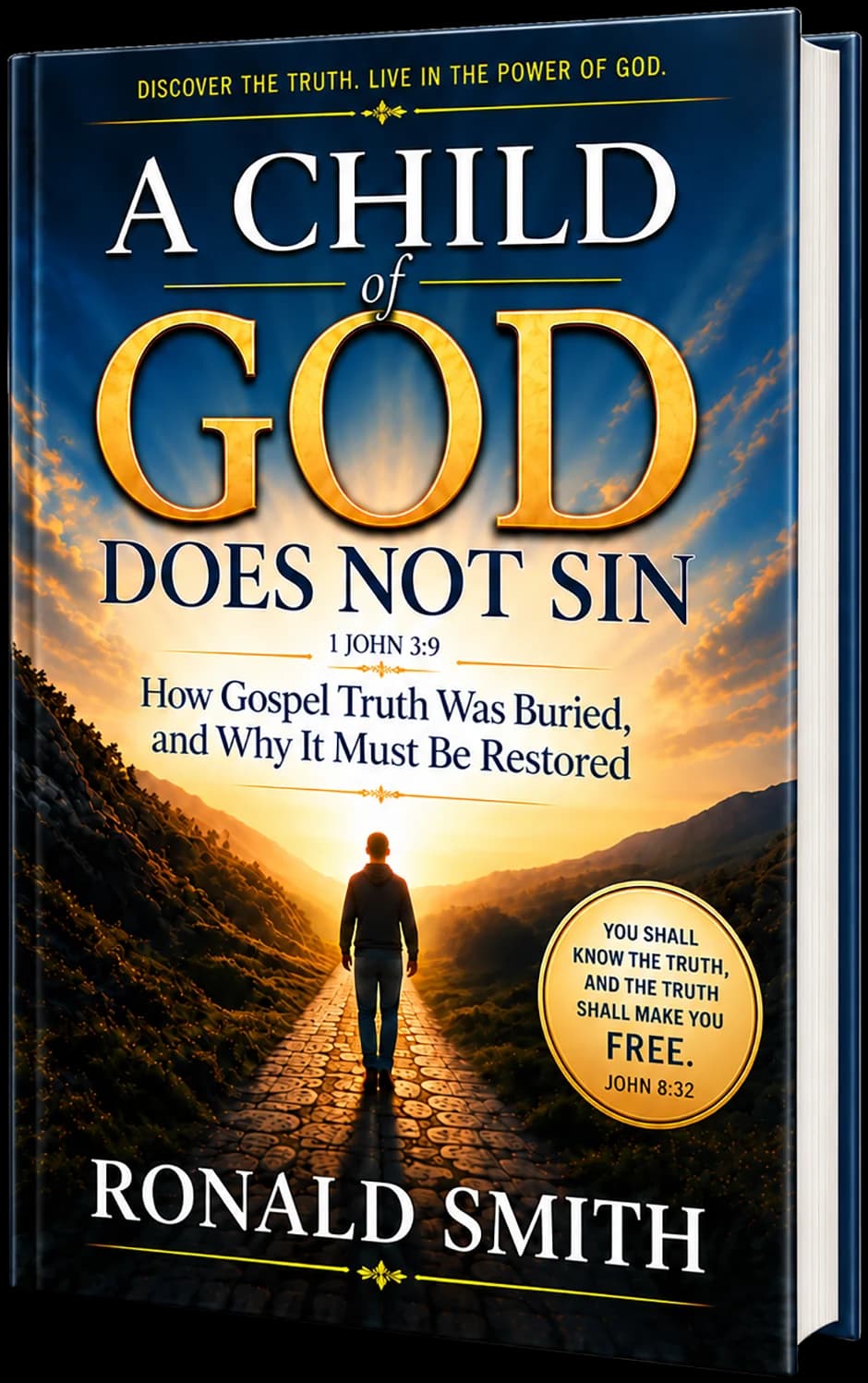
I go into this same before-and-after hinge — what actually changed the moment the Spirit stopped coming upon people temporarily and started coming into them permanently — in Chapter Six of my book, A Child of God Does Not Sin, "Before & After Pentecost: The Old Covenant vs. The New." It's the difference this whole book keeps coming back to, because almost nothing about what's actually possible for a believer makes sense without it.
A Child of God Does Not Sin releases on Amazon October 1, 2026.