I promised at the end of my last post that I’d come back to this, and I’ve been chewing on it ever since: I think the whole question “can you lose your salvation?” starts from a broken premise. Not a wrong answer — a wrong picture.
“Lose your salvation” makes salvation sound like a set of keys, or a wallet. Something you’re handed once, that you either keep track of or don’t. Careless people misplace their keys. Unlucky people get their wallet stolen. Either way, the object is the whole story — a thing you have, sitting in your pocket, until one day it isn’t there anymore.
I don’t think that’s the right picture. I think Scripture describes salvation less like an object you’re carrying and more like a roof over your head while it’s raining.
A grammar lesson that’s actually a theology lesson
Here’s something I didn’t fully appreciate until I started digging into the Greek: the New Testament doesn’t talk about salvation in one tense. It talks about it in three.
Ephesians 2:8 says believers “have been saved” — past tense, a completed action. Something real and finished. 1 Corinthians 1:18 describes believers as those who “are being saved” — present tense, ongoing, still happening right now. And Romans 5:9 promises that believers “shall be saved” from wrath — future tense, not yet arrived.
Theologians have names for this: justification (the completed part), sanctification (the ongoing part), glorification (the future part). But strip away the vocabulary and look at the grammar itself. The Bible’s own language for salvation isn’t a single snapshot. It’s a timeline. Something was finished. Something is happening. Something is still coming. A word that shows up in three different tenses in the same book, describing the same reality, is not describing a static object sitting in a drawer. It’s describing a rescue in progress.
To be fair, none of this is news to careful theology on either side of this debate. Nobody serious argues sanctification is instant and finished the moment someone believes. The real disagreement was never about whether the rescue is ongoing — it’s about whether that ongoing rescue is guaranteed to reach the destination no matter what, for everyone who genuinely begins it, or whether it’s actually possible, through the same willful, deliberate rejection Hebrews 10:26 describes, to walk out of it partway through. That’s the question the rest of this post is actually about.
Not “verb instead of noun” — both, and here’s why that matters
I want to be careful here, because it would be easy to overcorrect. The completed part is completely real. When Jesus said “It is finished” (John 19:30) — tetelestai, paid in full — that wasn’t a down payment on a plan you keep paying into. Adoption into God’s family, the legal reality of being made righteous in Christ, isn’t something you re-earn every morning. That’s the noun: a real status, genuinely granted, not performance-based, not something you build yourself one good day at a time.
But the noun isn’t the whole sentence. Having a roof over your house is a completed, once-built fact — the contractor finished the job, the roof is real, it isn’t rebuilt every time it rains. And yet the roof only does what a roof does while you’re actually standing under it. The construction is finished. The covering is continuous. Both true, doing different jobs.
That’s the picture I think Scripture is actually painting. The relationship is established, once, completely — adoption, justification, the new birth itself. And the ongoing protection from sin’s power — the actual, present-tense, moment-to-moment “being saved” — is something you’re living inside of, the way you live inside a house with a roof on it, not something separate you have to keep re-earning from scratch.
The roof, and where you actually have to go to get wet
Every time God’s power stops you from committing willful sin, that’s the roof doing its job. You didn’t do it by sheer willpower, gritting your teeth against a desire you still secretly wanted — that’s the “awakened man” from Chapter One, straining against the law with no indwelling power. This is different. This is the actual, ongoing “being saved” — a covering that’s real and active every single time you’re standing under it.
Here’s the sentence that matters most, and I want to be precise about it: stepping outside doesn’t mean tripping, stumbling, or getting caught in a moment of weakness. A single lapse isn’t walking out the front door — it’s more like a gust blowing rain in through a cracked window, which is exactly why Chapter One spends so much time on the difference between temptation, involuntary infirmity, and actual willful, deliberate consent. This was never a claim about moral perfection. The roof analogy is about deliberately, knowingly walking out from under the covering — sustained, willful, eyes-open — not about getting a little wet from an open window on a windy day.
But willfully walking out the front door while it’s raining is a different thing entirely. That’s not a draft finding its way through a cracked window. That’s a decision, made in full knowledge of what’s on the other side of the door, to step out from under the covering on purpose. And once you’re standing out there, soaked, you don’t get to claim you’re still dry because you were dry yesterday. The roof didn’t fail. You left the covering. That’s the entire distinction Hebrews 10:26 and Galatians 5:4 are describing, in Scripture’s own words, not mine.
And to close a gap I left open earlier: walking out doesn’t mean losing the ongoing covering while the underlying adoption quietly sits intact somewhere behind you, still yours on paper. Scripture doesn’t describe a two-tier believer who keeps a legal status while forfeiting everything that status was ever supposed to mean. Galatians 5:4 doesn’t say “estranged from Christ’s benefits.” It says estranged from Christ himself. It’s the same door. There isn’t a second one around back that stays open no matter what.
The strange, good sense in which even this ends one day
Here’s a thought that sounds like a trick question the first time you hear it, so let me set it up carefully before I say it: you won’t need a roof once you’re inside the house for good.
Salvation, in its ongoing, present-tense sense — the same phrase Paul uses in 1 Corinthians 1:18, “to us who are being saved” — is a rescue in progress, and rescues have a destination. The lifeboat matters enormously while you’re in the water. Nobody keeps clinging to the lifeboat once they’re standing on the dock. That’s not the rescue failing. That’s the rescue finishing the job it was sent to do.
The roof and the lifeboat aren’t two competing mechanisms — they’re the same rescue seen from two angles. The lifeboat is what God does: the sheer, undeserved fact of being carried. The roof is what that rescue looks like from inside your own days: a real choice, every day, to stay under what’s actually saving you rather than to walk out from under it on purpose. Grace doesn’t erase the choice. It’s what makes staying the thing you actually want to do.
So here’s the sentence, now that it has context: in a strange, technical, entirely good sense, even genuine believers stop needing “salvation” — once they’re home. Not because anything was lost. Because the thing being rescued from is no longer a possibility, and the thing being rescued toward has finally, fully arrived. You don’t lose the roof when you’re already standing inside the house it was built onto.
Why this actually changes the question
“Can you lose your salvation?” assumes salvation is a possession, so it asks a possession question: did you keep it or misplace it? I think that’s the wrong question, built on the wrong picture, and it’s part of why this debate keeps talking past itself.
The better question is the one Scripture’s own grammar is actually asking: are you currently standing under the covering, or have you deliberately, willfully walked out from under it? That’s not a question about a wallet you’re carrying. It’s a question about where you’re standing right now — and unlike a stolen wallet, it’s not decided by luck or circumstance. It’s decided the same way the rest of this book describes the Christian life: not gritted-teeth willpower holding the door shut against a nature that secretly still wants to leave, but a new nature that, moment to moment, simply doesn’t want to walk out anymore. Staying under the roof isn’t a performance you have to keep pulling off. It’s what the new birth actually produces.
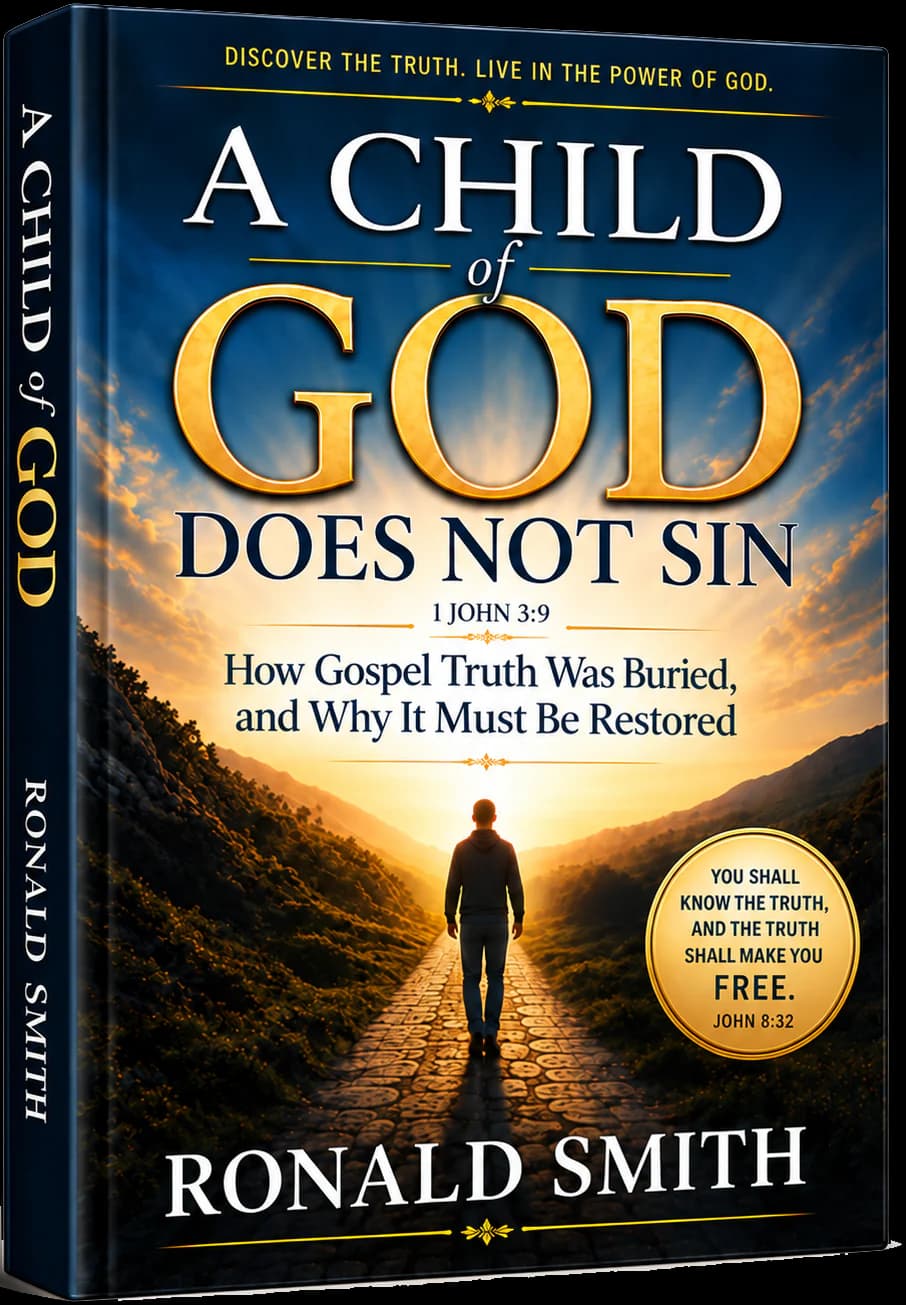
I write about the theology behind all of this — what genuine new birth actually changes, and what it means to walk in it day to day — throughout my book. A Child of God Does Not Sin releases on Amazon October 1, 2026.