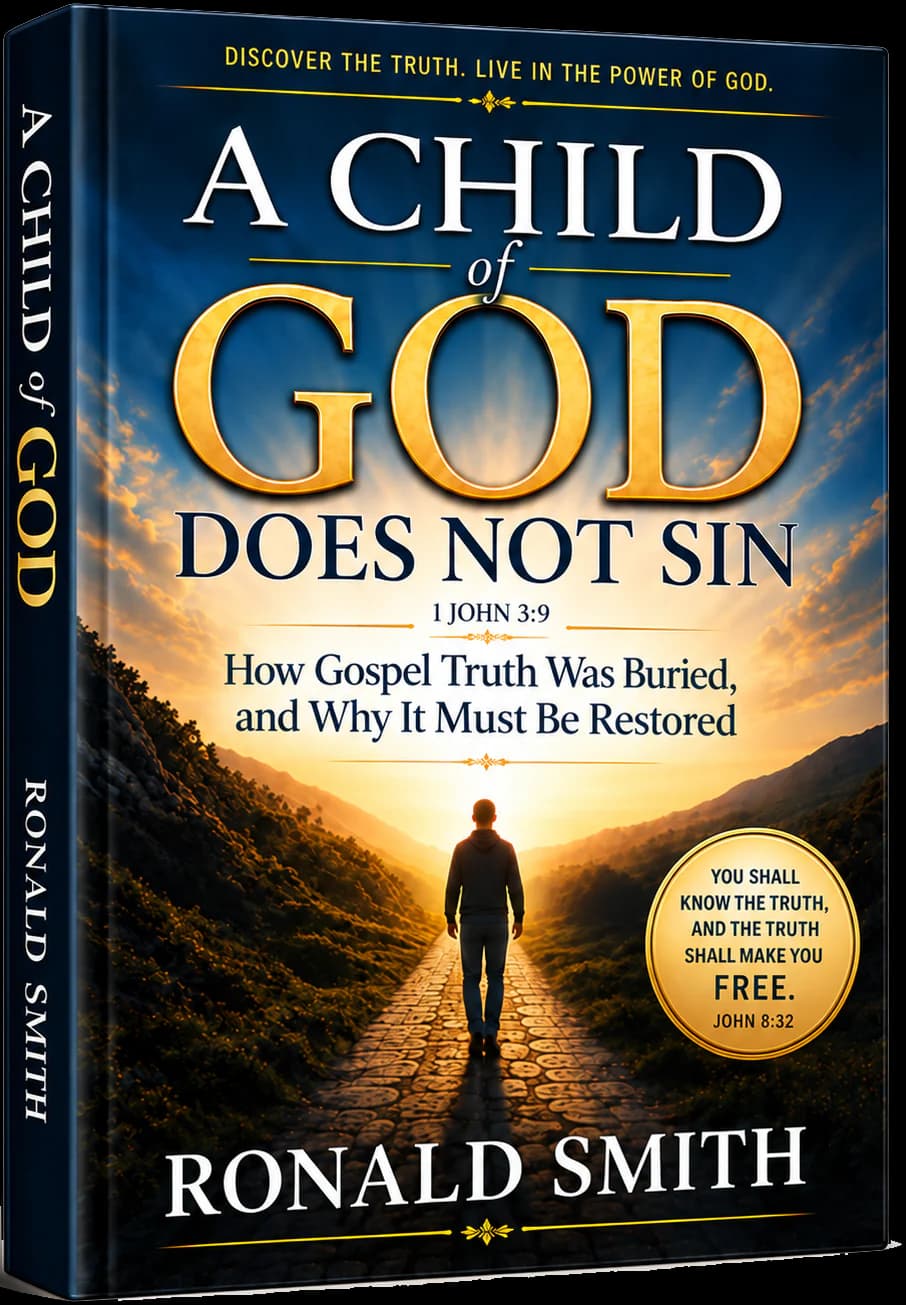
I came across a post on Facebook recently that stopped me mid-scroll, because it’s arguing the exact opposite side of the question this book spends its middle chapters on. The author’s case, in short: the warning in Hebrews 10:26 about “sinning willfully” has nothing to do with a believer’s everyday moral failures. It was written to Jewish believers under pressure to return to temple sacrifice, and reading it as a threat to ongoing salvation turns the gospel into an anxiety-driven performance review. Her conclusion: salvation, once given, cannot be lost, full stop — “it’s grace, period.”
I’m not going to name her or link the post. That’s not the point of this, and it isn’t a takedown of a person. But the argument itself is worth taking seriously, because it’s not a fringe position — it’s a widely-held one, argued sincerely, and it deserves a real answer instead of a dismissal.
Where I actually agree with her
Before I push back, I want to be honest about the ground we share, because it’s more than you’d think.
She’s right that tetelestai — “it is finished” — means the payment was complete. Nobody serious disputes that. She’s right that salvation isn’t earned by works, and she’s right that good works are the evidence of new birth, not the maintenance fee that keeps it running. I’d have written that last sentence myself. That’s not a minor concession — it’s the actual foundation both of us are building on.
Where we part ways isn’t over whether the cross was sufficient. It’s over a completely different question: can a person who has genuinely received that gift knowingly, deliberately walk away from it? “The payment was complete” and “can the recipient reject it” are two separate questions, and answering the first one — loudly, and correctly — doesn’t touch the second.
The half-verse problem, again
Her strongest proof-text is 2 Timothy 2:13: “If we are faithless, He remains faithful — for He cannot deny Himself.” It’s a real verse, and it says something true. But it isn’t the whole paragraph. The verse right before it says: “If we deny Him, He also will deny us” (2 Timothy 2:12). Same breath, same author, same thought. You can’t quote the comforting half of a two-part statement and leave the warning half on the floor — and I write about this exact pattern at length in my own book, because it shows up constantly. Twisted Scripture, almost every time, is a half-quoted verse, not a misquoted one.
The same thing happens with Hebrews 10:26-27 itself. Her reading stops at “there’s no backup sacrifice left” — a purely structural, almost administrative point, nothing personal, nothing at stake. But the very next verse doesn’t stay administrative: “a certain fearful expectation of judgment, and fiery indignation which will devour the adversaries” (Hebrews 10:27). That’s not neutral bookkeeping language about an empty temple. You don’t get to keep the sentence you’re quoting and lose the one right after it.
A category, not a single historical instance
She makes a genuinely good linguistic point: the Greek word behind “willfully” in Hebrews 10:26 is hekousios — intentional, premeditated, a deliberate choice, not an accidental stumble. She’s right about the word. Where I think the argument goes wrong is the next step: she treats that word as if it can only ever mean one specific historical thing — a first-century Jewish believer returning to temple sacrifice — rather than what it actually is: a category. Deliberate, willing, eyes-open rejection of known truth. The original readers’ particular temptation was one instance of that category. It was never the only possible instance the word could describe, any more than “murder” only describes the first murder anyone ever heard about.
One honest boundary worth naming: the immediate context of Hebrews 10:26 — “there no longer remains a sacrifice for sins” — is describing something total: rejecting the atonement itself, not any single unrepented sin in isolation. That passage, on its own, proves apostasy is real and dangerous. It doesn’t, by itself, prove that every unrepented willful sin carries identical weight. That’s exactly why this argument can’t rest on one passage. It’s why the case has to be cumulative — which is where 1 John 3:9, and the fifty-five verses standing behind it, come in.
Warnings aren’t theater
Here’s the argument I find hardest to get around, and it’s not mine — it’s the author of Hebrews’ own. If genuine believers truly cannot fall away under any circumstance, what is Hebrews 6:4-6 doing in the same book? “It is impossible for those who were once enlightened, and have tasted the heavenly gift, and have become partakers of the Holy Spirit... if they fall away, to renew them again to repentance.” That’s not describing outsiders. That’s describing people who were enlightened, who tasted the heavenly gift, who were partakers of the Holy Spirit — and then fell away. If that outcome is theologically impossible, the author of Hebrews spent two separate passages warning real people about a danger that, on this reading, cannot exist. A warning addressed to people who cannot possibly experience the thing being warned about isn’t a warning. It’s theater. And this book doesn’t read like theater — it reads like someone who meant every word of it.
The standard reply to this is that the warning is simply the means God uses to keep the truly elect persevering — addressed seriously to a mixed congregation, without requiring that a genuinely regenerate person could actually be the one who falls. That’s a coherent system. But it has a cost: it requires reading “those who were once enlightened, and have tasted the heavenly gift, and have become partakers of the Holy Spirit” as language that can describe people who never actually partook of anything real. Paul says something similar and even more direct in Galatians 5:4, to people he’s addressing as believers: “You have become estranged from Christ, you who attempt to be justified by law; you have fallen from grace.” At some point the words have to mean what they say, or the whole warning genre in the New Testament becomes a description written for an audience that, by definition, cannot exist.
The verse nobody wants to touch
Here’s the part that actually motivated me to write this book, more than any single argument above. I’ve read a lot of “other side” pieces by now, some far more careful than this one, and there’s a pattern that holds every single time without exception: nobody engages with the plain words of 1 John 3:9. Not once. “Whoever has been born of God does not sin, for His seed remains in him; and he cannot sin, because he has been born of God.” It gets explained around. It gets softened in translation. It gets reframed as “doesn’t make a practice of it” or “doesn’t habitually sin.” Anything except actually addressed as it’s written.
To be clear, since I can’t re-argue the whole book in a blog post: this was never a claim about moral perfection. Mistakes, ignorance, temptation, the ordinary infirmities of living in a fallen world — none of that is what’s in view. This is specifically about willful, deliberate sin, and that one distinction is the thing that trips up almost everyone the first time they hear this argument.
Her original point about anxiety deserves a direct answer here too, because it’s a real pastoral concern, not just a rhetorical one. Genuine conviction from the Spirit points at one specific thing, you deal with it, and it lifts. If a question just keeps circling back no matter how many times you’ve already answered it, that’s not conviction anymore — that’s something closer to scrupulosity, and it deserves a counselor, not another sleepless night re-litigating a settled verdict. This doctrine was never meant to produce that kind of anxiety. It was meant to answer it.
And it’s not just that one verse. The book lays out fifty-five more that build the same case from fifty-six different directions — Old Testament and New, prophecy and epistle, promise and command. In every conversation I’ve had and every post I’ve read arguing the other side, the pattern holds: the plain words get walked past, never wrestled with head-on. That silence is not nothing. If the plain reading were actually wrong, someone would have taken it apart by now instead of routing around it.
What this actually comes down to
I don’t think this is really an argument about whether Jesus is a perfect Savior. We agree completely on that — she said it herself, and so would I, without hesitation. The actual disagreement is much narrower and much more testable: does the New Testament describe genuine new birth as producing an actual change — a new nature that no longer walks in willful, deliberate sin — or does it describe a legal status that sits on top of a person’s life unchanged regardless of what they do with it afterward?
That’s the question this whole book is built to answer, verse by verse, half-verse by half-verse, starting with what “willful sin” actually is and ending with what genuine freedom from it actually looks like.
So, can you become unsaved? Scripture doesn’t hedge on this the way “it’s grace, period” wants it to. Not through an off day, a bad decision, or ordinary human failure — but through the same willful, deliberate walking-away Hebrews and Galatians both describe in believers, by name. That’s the sober flip side of a real gospel: it only means something because it’s actually possible to reject it, even after genuinely receiving it.
There’s a deeper question sitting underneath this whole conversation, though, and it’s worth its own post: is “salvation” even the right kind of word for what’s actually happening — a thing you either have or don’t, like a set of keys you could misplace — or does Scripture describe it more like a verb than a noun, an ongoing rescue rather than a one-time deposit? I think it’s the second one, and I think it changes how this whole question should even be asked. More on that soon.
If this is a conversation you’ve had before — with a friend, a pastor, or just with your own conscience — A Child of God Does Not Sin releases on Amazon October 1, 2026, and it goes considerably deeper into every one of these passages than a blog post ever could.