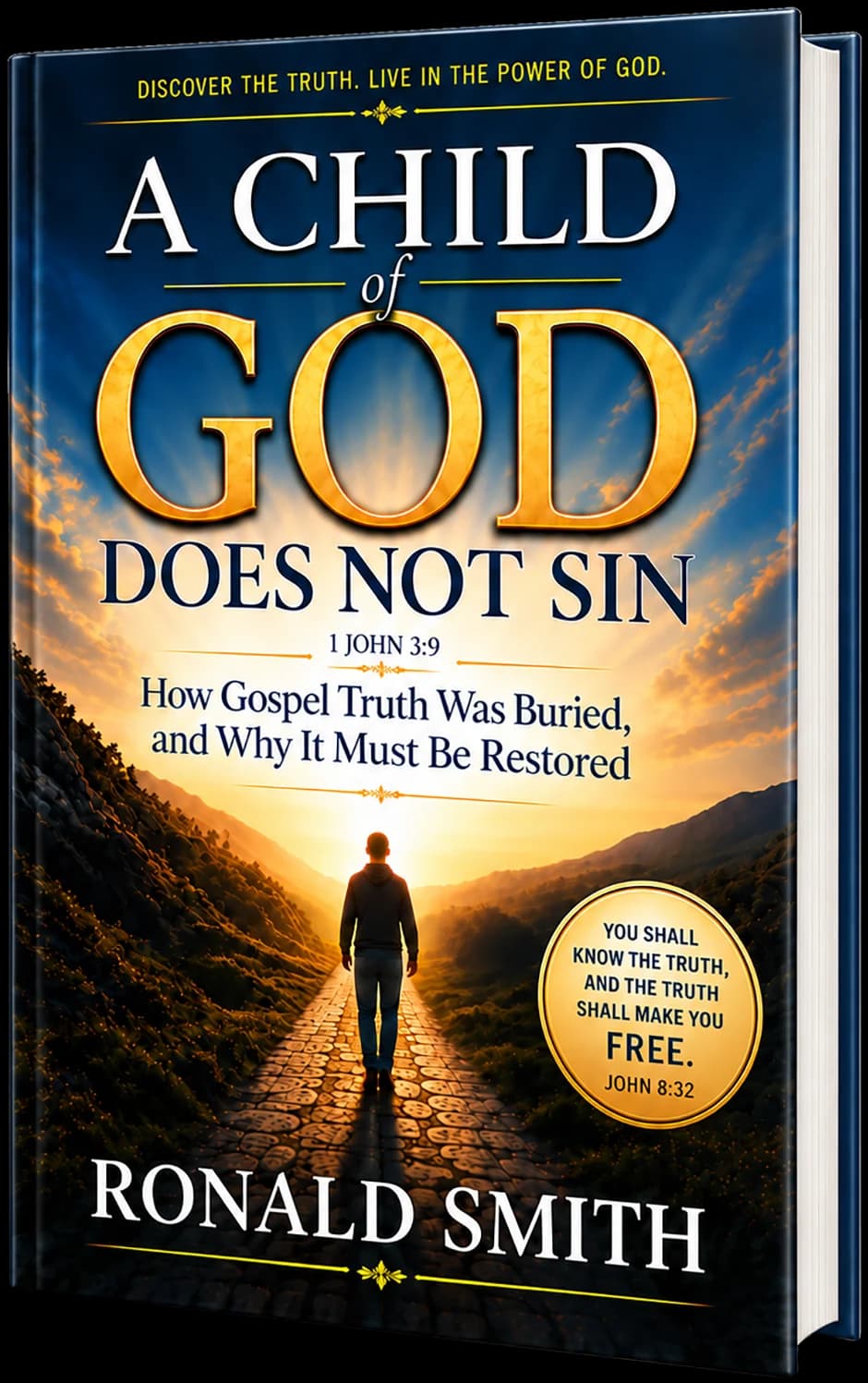
I came across a short message from Pastor Trevor Meier that asks a sharp question: who turned "change your mind" into "do penance"? His answer includes a piece of church history that fits my book, A Child of God Does Not Sin. It also raises a question I care about more: what kind of repentance actually stops willful sin? By sin I mean what the book means by it, a willful transgression of a known law of God, not mistakes, ignorance or ordinary human weakness.
What Jesus actually said
"Repent, for the kingdom of heaven is at hand" (Matthew 4:17, NKJV). John the Baptist opened with the same words in Matthew 3:2. The Greek verb is metanoeō, and the noun form is metanoia. It means a change of mind, a rethinking that turns a person in a new direction. It is not a feeling, and it is not a payment.
Mark 1:15 pairs it with a second command: "Repent, and believe in the gospel."
Where "penance" came in
Around 382 AD, Pope Damasus asked a scholar named Jerome to revise the Latin Gospels. Jerome's work grew into the Latin Vulgate, the Bible of the Western church for more than a thousand years. In Matthew 3:2 and 4:17 he wrote Poenitentiam agite. Bibles translated from the Vulgate, such as the Douay-Rheims, give it in English as "Do penance, for the kingdom of heaven is at hand."
It is fair to add that this is more complicated than "Jerome got it wrong." The Latin word poenitentia did not start out meaning the medieval sacrament. But as the church built its system of confession, satisfaction and penance, those Latin words were heard through it. In 1516 Erasmus published a Greek New Testament with a new Latin translation and chose different wording: first poeniteat vos, "be penitent," and later resipiscite, "come to your senses."
The result is that an announcement about a kingdom became an assignment: do something to get right with God.
The same drift, a different direction
In my book, Chapter Eight lists Mark 1:15 among the examples of Twisted Scripture, and Chapter Nine comes back to it under the heading "The Double Twisted." Here is how I put the first layer: "The Greek word is metanoia — a complete change of mind and direction, not a feeling. Somewhere along the way, repentance was reduced to remorse: feel bad for a few minutes, thank God He's got your back, move on. The word stayed on the page. What people think it means did not."
No word was removed. That is what makes it Twisted Scripture. Trevor's history shows a second drift in the same verse: metanoia grew into a ritual of doing penance. They are different distortions, but they move the same way. Both take repentance away from the mind and turn it into something you feel or something you perform.
The verse has another layer too, because "believe the gospel" has been narrowed as well, which is why the book calls it the Double Twisted. This post is about the first command.
Why feeling bad isn't enough to stop willful sin
Sorrow is not the problem. Paul says "godly sorrow produces repentance leading to salvation" (2 Corinthians 7:10, NKJV). The problem is stopping at sorrow. Remorse and penance have one thing in common: neither requires you to change what you believe. You can feel awful about a willful sin, even do something to make up for it, and walk straight back into it on Tuesday, because nothing about the way you think has changed.
There is a third version that looks stronger, and it is common in churches that would never use the word penance. Repentance is defined as "turning from sin," and the person really does turn. But often the turn is man-made: a resolve, a fresh start, a promise to try harder. He turns, but he has not fully surrendered, and he has not agreed with God about what he is turning from or who is going to keep him from it. That turn is a start, but it is not the change God requires, because a turn made in your own strength is still something you perform.
In Chapter Two of the book I argue that the root of sin is unbelief, and that unbelief has three faces, which I call the three traps. Willful sin continues as long as any one of them is still in place. A real change of mind, metanoia, means agreeing with God on all three. Even that agreement is His work in us. God "has also granted to the Gentiles repentance to life" (Acts 11:18), and "it is God who works in you both to will and to do for His good pleasure" (Philippians 2:13).
- It is sin. The first trap is not believing that what you are doing is really sin. "Everyone does it." "It's a weakness, not a sin." "God's grace covers it."
- Sin has real consequences. The second trap is not believing the consequences are real. In the book I use a steak you have been told contains arsenic. If you believe it, you push the plate away, and it takes no willpower at all.
- Jesus came to keep me from it, not only to forgive me after. The third trap is not believing that freedom from willful sin is possible in this life. But Paul writes, "sin shall not have dominion over you, for you are not under law but under grace" (Romans 6:14), and "the law of the Spirit of life in Christ Jesus has made me free from the law of sin and death" (Romans 8:2). Jude praises the One "who is able to keep you from stumbling" (Jude 24). And right after promising the Holy Spirit as "another Helper" (John 14:16), Jesus said, "I will not leave you orphans; I will come to you" (John 14:18). He came to live in His people by the Spirit, and He did not come only to forgive them when they sin. He came to keep them from it.
Feeling bad leaves all three traps standing. You can feel terrible and still call it a weakness, still doubt the consequences, still be sure you will always struggle. That is why the old cycle never breaks: sin, guilt, a promise, and then the same sin again. When you agree with God on all three, the behavior follows from the belief.
That does not make it passive. The same letter of Jude that says Jesus is able to keep us from stumbling also says, "keep yourselves in the love of God" (Jude 21). He keeps us, and we keep ourselves, watching and walking by the Spirit. And John does not leave the one who falls where he fell: "My little children, these things I write to you, so that you may not sin. And if anyone sins, we have an Advocate with the Father, Jesus Christ the righteous" (1 John 2:1). The goal is that you not sin. The Advocate is there for the one who stumbles, and it is the way back, not a license to keep going.
What leads to repentance
Paul says it plainly: "Do you despise the riches of His goodness, forbearance, and longsuffering, not knowing that the goodness of God leads you to repentance?" (Romans 2:4, NKJV). Some translations say "kindness." Either way, the engine of repentance is what you come to know about God, not how guilty you can make yourself feel.
That matches what happened to me, which I describe in the book. Genuine metanoia was a change of mind about Him, not about myself first. I had facts, and I had agreement with the facts. What changed me was a different view of who He is and what He did, and the rest followed.
Not a loophole
I want to be careful here. A change of mind that never changes anything is not what Scripture describes. John the Baptist told the crowds, "Therefore bear fruits worthy of repentance" (Luke 3:8), and Paul told Agrippa that people should "repent, turn to God, and do works befitting repentance" (Acts 26:20). Real repentance shows up in a real life. The point is the order. Fruit follows the changed mind. It does not purchase it.
This is why the book says a child of God does not sin, meaning willful sin. If you have truly changed your mind about who God is, you are not trying to earn your way back in. You are living in what He has already done.
So the next time you hear "repent," ask what you are being told to do. Is it a change of mind that turns your life, or a performance meant to put God in a better mood?
A Child of God Does Not Sin is now available on Amazon.