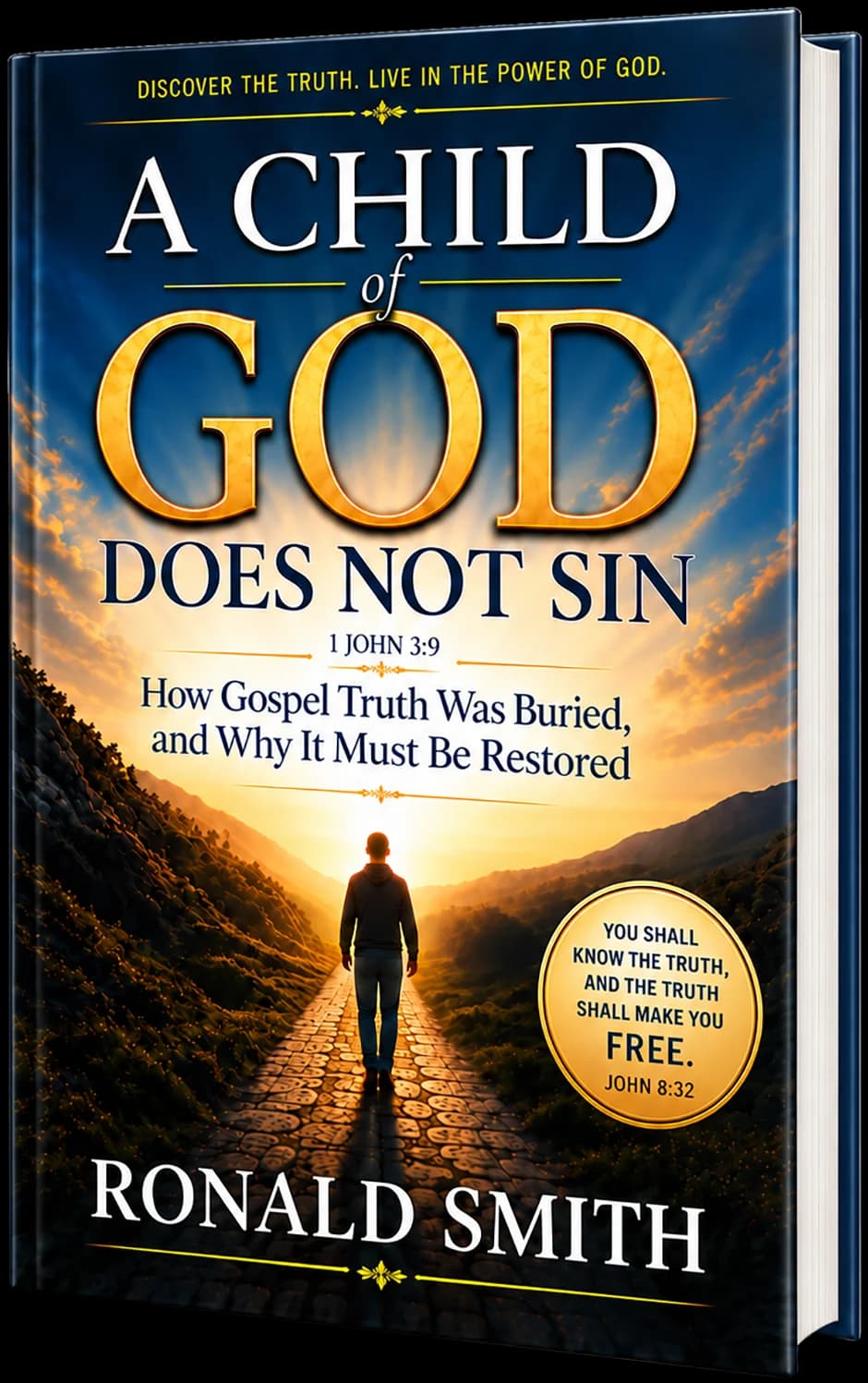

I've been putting the final touches on my book, A Child of God Does Not Sin, and the title alone raises a fair question: does that mean literal, zero-exception sinlessness — never a mistake, never an unintentional stumble? No. The book is specifically about willful sin: the deliberate, knowing choice to disobey. Honest mistakes, ignorance, and unintentional lapses are a different category Scripture treats differently, and I don't want anyone assuming the title claims more than it does.
But since the core verse behind the title is 1 John 3:9, there's a related question worth spelling out further here. Here's the verse itself: "Whoever has been born of God does not sin, for His seed remains in him; and he cannot sin, because he has been born of God" (1 John 3:9, NKJV). Doesn't the Greek verb tense here already mean "habitually" — as if even willful sin is fine, as long as it isn't a repeated habit — even though the word itself never appears in the text?
A quick review of the Greek
The Greek present tense does carry an ongoing sense, which is precisely why modern translations have increasingly leaned that direction — the NASB renders it "practices sin," the ESV "makes a practice of sinning," the NIV "will continue to sin," and the Amplified Bible — whose whole method is bracketing out shades of a word's possible meaning, a different project than NASB's or ESV's plain-text choices — goes furthest of all, printing the word "habitually" directly into the verse: "cannot habitually [live a life characterized by] sin." Modern-day scholars like Simon Kistemaker, Kenneth Wuest, and John Stott read the underlying tense the same way. But "ongoing" doesn't mean what most people assume it means, and that's the actual issue worth untangling.
| Translation | Year | 1 John 3:9 wording |
|---|---|---|
| KJV | 1611 | "does not sin" |
| Amplified | 1965 / rev. 1987 | "cannot habitually… sin" |
| NASB | 1971 | "practices sin" |
| NIV | 1978 | "will continue to sin" |
| NKJV | 1982 | "does not sin" |
| NLT | 1996 | "do not make a practice of sinning" |
| ESV | 2001 | "makes a practice of sinning" |
"Ongoing" isn't one thing — it's at least two
Here's what actually settles this, and it's simpler than the grammar debate makes it sound. Think about English for a second. If I say "he runs every morning," that's ongoing — he does it repeatedly, over and over. But if I say "a cheetah runs fast," that's the exact same verb, same form — and I'm not counting how many times a cheetah runs. I'm telling you what a cheetah is. Same grammar, two completely different jobs. One is counting repeated events. The other is describing a nature.
Greek has that same split, and it's a real, recognized category — grammarians call the ongoing side of the present tense its "aspect," and then separately ask what specific kind of ongoing action that aspect is describing in a given sentence: repeated individual instances, or a general statement about what something is. The tense-form itself doesn't decide which one you're looking at. Context does.
So which one is 1 John 3:9?
Is John counting up individual sins like a tally, or describing what a child of God is — the same way "a cheetah runs fast" describes what a cheetah is? Context settles it. Two chapters earlier, John already wrote: "If we say that we have no sin, we deceive ourselves, and the truth is not in us" (1 John 1:8, NKJV). He already knows believers still sin in the ordinary sense — he's not walking that back in chapter 3. What he's describing there is something else entirely: a new nature that's simply incompatible with willful, deliberate sin. That's a statement about character, not a frequency count. Same present tense. Different job.
This isn't actually a new fight
Long before Kistemaker, Wuest, or Stott, someone else already fought this exact insertion — from the other side. In Sermon 18, "The Marks of the New Birth" (1748), John Wesley took on preachers of his own day who were already softening this verse the same way:
"But some men will say, 'True: Whosoever is born of God doth not commit sin habitually.' Habitually! Whence is that? I read it not. It is not written in the Book. God plainly saith, 'He doth not commit sin;' and thou addest, habitually! Who art thou that mendest the oracles of God?"
Worth being fair here: in Wesley's day, that qualifier was still something a preacher added out loud in the moment, not a formal decision a translation committee reached after working carefully through the Greek. Most of the translators who eventually leaned this direction weren't corrupting the text out of bad motive — they were making the same kind of good-faith call Kistemaker, Wuest, and Stott made above, a real, defensible reading of an aspectual nuance. But the word Wesley said was "not written in the Book" moved from the pulpit onto the printed page anyway, within about two centuries — and today it's sitting in print for any reader to find.
Why this actually matters, beyond winning an argument
If "habitual" is the standard, nobody can tell you where the line is. Once a week? Once a month? "Habitual" was never built to have a floor — which is exactly the objection Reformed theologian John Murray raised against this reading, calling it insufficiently defined and a loophole for what John actually wrote. "Willful" doesn't have that problem. It's a test anyone can actually run on their own life in real time: did I know this was wrong, and choose it anyway, right now? That's a line. "Habitual" was never a line — it was a moving target that happened to always land just past wherever the reader already was.
Where this leaves the grammar fight
I'd rather concede the part that's actually true — the present tense is genuinely ongoing in aspect, full stop — than pretend that concession costs me anything. It doesn't. The real question was never whether 1 John 3:9 is describing something ongoing. It obviously is. The real question is what kind of ongoing thing: a body count, or a nature. Once you see that those are different questions, "habitually" stops looking like the neutral, obvious translation and starts looking like exactly what Murray called it — an insertion that solves a problem the text never actually had.
This ended up making it into the book after all — you'll find it at the very end of Chapter Twelve, under its own heading: "A Deep Dive on 1 John 3:9 and Drift Over Time." I just wanted to give it room to breathe here too, since it's the part that tends to trip people up first.
A Child of God Does Not Sin releases on Amazon October 1, 2026.