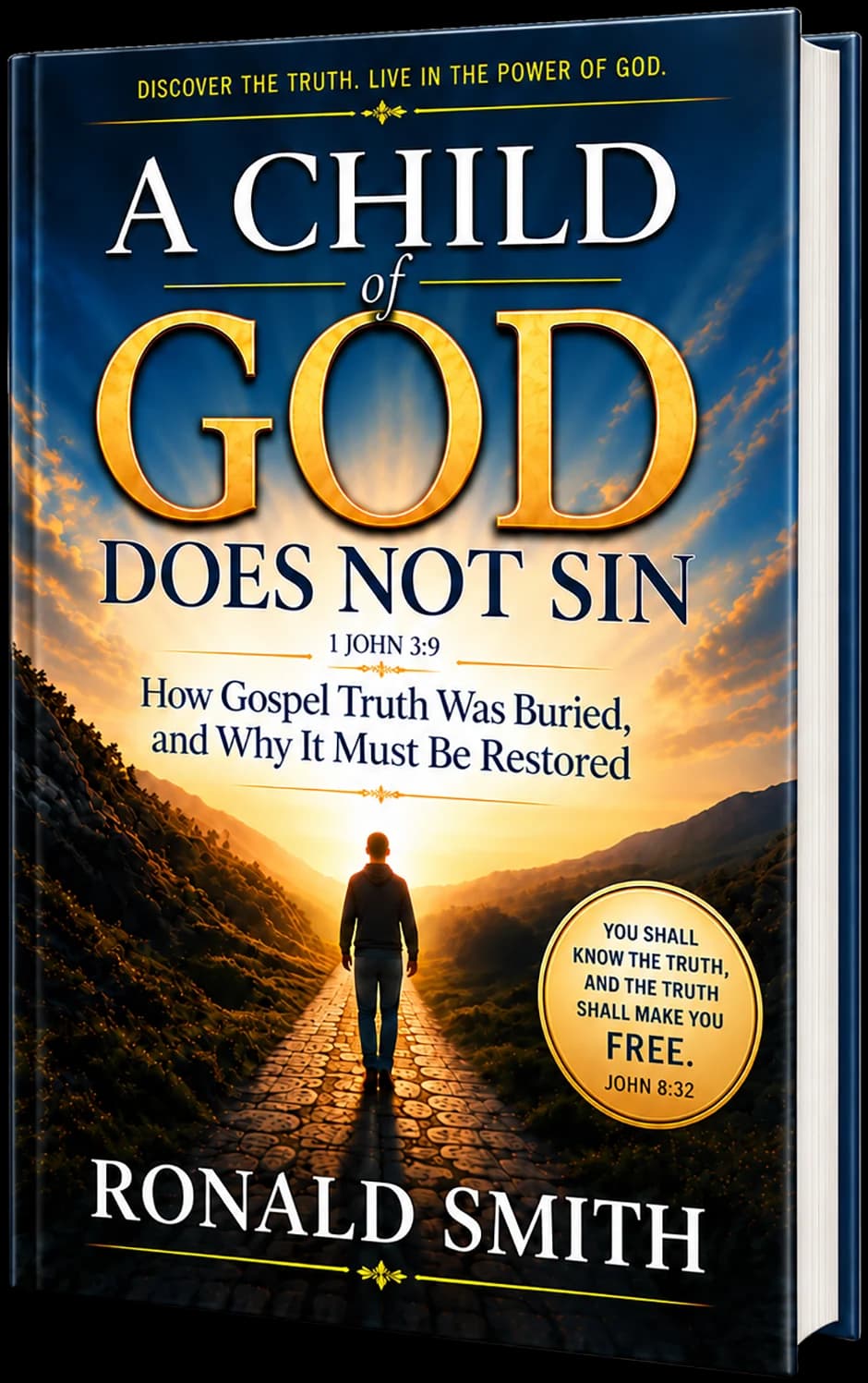

Here is the sharpest question anyone has asked me about my book, A Child of God Does Not Sin: "Say you're right that a child of God doesn't sin willfully. Grace covers me anyway when I fall, so what's the point of your whole book?" It's a fair question, and everything in the book hangs on it.
This post looks at the intersection of two points that seem, on the surface, to conflict: 1) a child of God does not sin, and 2) God's grace covers believers who fall into sin. I make the case for both in my book, so here I'll take them as given, knowing some readers see them differently.
The short answer is that grace does cover you, again and again, when you turn back to Christ. What it doesn't do is work as a license for someone who plans to sin again. Hebrews 10:26-29 warns about a person who deliberately and finally rejects Christ (more on that below). That is not about counting failures. It is about a person who turns away for good.
First, yes: grace covers you
Let me say this clearly, so nobody mistakes what comes next. If you have sinned, even willfully, and you turn back to Christ, grace covers it. The cross is enough. John Wesley, the founder of Methodism, preached the same. In his sermon "A Call to Backsliders," he says those who had fallen were restored "very frequently in an instant, to all that they had lost." He asks whether those who have really fallen away ever find mercy, and he answers: "Yea, verily; and not one, or an hundred only, but, I am persuaded, several thousands." Nothing in this post takes that away. But forgiveness is only half of what grace does.
Grace does far more than cover: it also empowers
In the Bible, grace does both jobs. It forgives, and it empowers, and the context tells you which one is in view. Grace has two meanings in Scripture: unmerited favor (God forgiving us when we don't deserve it) and enabling power (God giving us the strength to do what we could never do on our own). Wesley saw both. In his sermon "The Witness of Our Own Spirit," he explains that "the grace of God" sometimes means "that free love, that unmerited mercy, by which I a sinner, through the merits of Christ, am now reconciled to God." But about 2 Corinthians 1:12, he says, "it rather means that power of God the Holy Ghost, which 'worketh in us both to will and to do of his good pleasure.'"
Most people have never heard the second one, but the Bible uses it constantly. Jesus tells Paul, "My grace is sufficient for you, for My strength is made perfect in weakness" (2 Corinthians 12:9), putting grace and strength side by side. Paul says, "by the grace of God I am what I am, and His grace toward me was not in vain; but I labored more abundantly than they all, yet not I, but the grace of God which was with me" (1 Corinthians 15:10), with grace doing the work. Hebrews invites us to the throne of grace "that we may obtain mercy and find grace to help in time of need" (Hebrews 4:16). Mercy is for what we have done. Grace is the help for what we face.
Once you see that second meaning, Romans 6:14 comes into focus: "For sin shall not have dominion over you, for you are not under law but under grace." The verse begins with a promise about sin's power and then gives the reason. The law could tell us what to do, but because of our flesh it was "weak" and could not make us do it (Romans 8:3). Grace supplies the power the law could not give. Sin loses its dominion because grace is God's power at work in us, not just His pardon declared over us. If we base our theology only on the first meaning, that is what I call in my book the half-gospel, because we have forgotten the second.
Here is how that plays out in the verse people quote most about grace. Paul writes, "where sin abounded, grace abounded much more" (Romans 5:20). Most of us read that with the first meaning in mind: God's forgiveness is bigger than my sin. But that isn't the meaning Paul is using here. He has the second one in view. Read his very next sentence: "so that as sin reigned in death, even so grace might reign through righteousness to eternal life" (Romans 5:21). Sin reigned. Grace reigns. And Paul says grace reigns "through righteousness," meaning it takes over by producing righteousness in us. Grace in this usage is not a cleanup crew arriving after the damage is done. It is God's power overpowering sin itself. That is why there is no shortage of grace: there is no shortage of its power. The only limit is a person who refuses it. So many people read this verse the other way that I am putting it back here after first deleting it to shorten, and I deal with it more fully in my book.
So why does 1 John 3:9 matter? Six reasons
1. Because "covered" is only half of the gospel. Wesley put the two halves side by side in "The Scripture Way of Salvation": "By justification we are saved from the guilt of sin, and restored to the favour of God; by sanctification we are saved from the power and root of sin, and restored to the image of God." Covered is the first half. The second half is power. If 1 John 3:9 means what it says ("Whoever has been born of God does not sin, for His seed remains in him"), then freedom isn't just forgiven. It's promised. And to not believe that promise is what my book calls Trap Three: deciding freedom isn't possible, so why try?
2. Because grace was given to change us, not just to cover us. Titus 2:11-12 says "the grace of God that brings salvation has appeared to all men, teaching us that, denying ungodliness and worldly lusts, we should live soberly, righteously, and godly in the present age." Paul asks, "Shall we continue in sin that grace may abound?" and answers, "Certainly not! How shall we who died to sin live any longer in it?" (Romans 6:1-2). Grace that never changes anything has missed its own purpose.
3. Because "covered" is received by turning back, not assumed. This is where Hebrews 10 comes in. The writer of Hebrews says the worst insult is to have "insulted the Spirit of grace" (Hebrews 10:29). Grace can be insulted, and the way to insult it is to treat it as a permission slip. Jude warns about people "turning the grace of our God into lewdness" (Jude 4). The one who says "I'm covered anyway" and keeps going is on the road that warning describes. The difference between the one who sins and turns back, and the one who is testing God, is what each does next.
Think of it this way: choosing sin is like driving off the road God laid out for us. Sure, we can usually find our way back, but we need to be acutely aware that while we are off the road, we are no longer following Him, no longer under His protection, and outside His will. Jesus draws the line plainly: "If anyone loves Me, he will keep My word; and My Father will love him, and We will come to him and make Our home with him. He who does not love Me does not keep My words" (John 14:23-24). We lose the peace, freedom, and privilege of walking with Him, and we land in the consequences of our own choices.
4. Because obedience is how love shows, and how we stay in the relationship. This is not cold rule-keeping. John says, "For this is the love of God, that we keep His commandments. And His commandments are not burdensome" (1 John 5:3). Wesley saw the same thing when he wrote that "there is no motive which so powerfully inclines us to love God, as the sense of the love of God in Christ." Love is the engine, and obedience is what it produces. In Chapter Three of my book, I stack ten verses where Jesus and His apostles say the same thing, over and over, on purpose. Here is one: "If you keep My commandments, you will abide in My love" (John 15:10). Notice "abide." Wesley uses the same idea in his sermon on 1 John 3:9, where he says a believer sins willfully only "if he abide not in the faith." Obedience doesn't earn the relationship. It is how we stay in it.
5. Because holiness is where this is going. "Pursue peace with all people, and holiness, without which no one will see the Lord" (Hebrews 12:14). Being covered isn't the destination. Seeing the Lord is, and the goal Scripture sets for the road there is holiness.
Scripture says it more than once. "No fornicator, unclean person, nor covetous man, who is an idolater, has any inheritance in the kingdom of Christ and God" (Ephesians 5:5). "Do you not know that the unrighteous will not inherit the kingdom of God? Do not be deceived" (1 Corinthians 6:9).
These verses don't say we earn heaven by being good. Scripture teaches two things about righteousness: it is imputed (credited to our account) and it is imparted (worked into us). Wesley put it carefully: God "implants righteousness in every one to whom he has imputed it," not "as the ground of our acceptance with God, but as the fruit of it." As my book puts it, imputation without impartation leaves the gospel only half told.
If sin cannot live in God's presence, then a faith that makes peace with ongoing sin has made peace with being unfit for that presence. The question isn't only "am I covered?" It is also "is the thing in me that keeps choosing disobedience being fixed, here and now, while I still have time?"
6. Because the evidence shows what happens when we don't believe it. God's grace gives us the power to obey, so you would expect Christians who are living in it to look different from everyone else. But in a widely cited 2008 Barna study, born-again adults who had been married had divorced at almost the same rate as everyone else: 32% versus 33%. The word "holy" means "set apart," so that is evidence that the standard is not being met and that the power is going unused.
Why does that happen? Most Christians know they shouldn't sin, but the evidence says we do anyway. Psychologists call that cognitive dissonance: the brain holds two contradictory beliefs at once and learns to live with both. "I know the verse says obey Him, but I also know I'm saved even though I don't always obey." The brain doesn't resolve the contradiction. It just stops noticing it. I submit that a main reason is that we don't believe the absolute truth of 1 John 3:9. If you've been transformed by the renewing of your mind and now believe that a child of God does not sin, you can't leave that contradiction alone. If you quietly believe it can't be true, the discomfort disappears, and so does the fight.
The real conversation
The real conversation is about the state of our soul when we choose to disobey: what is true of us from the moment we leave the road until the moment we return. That is what 1 John 3:9 is about. "Whoever has been born of God does not sin, for His seed remains in him; and he cannot sin, because he has been born of God." In short, the verse plainly says that willful sin is not something a child of God does. It doesn't just say he doesn't. It says he cannot. So if a person has separated himself from God, by definition he is no longer a child of God. That is the plain meaning of the words, and Jesus said the same about abiding: "If anyone does not abide in Me, he is cast out as a branch and is withered" (John 15:6).
Given that, the question becomes: "How many times can I walk away and still return?" Scripture is clear that there is a limit, and it isn't a number. It is the point where a person becomes guilty of insulting the Spirit of grace, which is how Hebrews 10:26-29 puts it:
"For if we sin willfully after we have received the knowledge of the truth, there no longer remains a sacrifice for sins, but a certain fearful expectation of judgment, and fiery indignation which will devour the adversaries. Anyone who has rejected Moses' law dies without mercy on the testimony of two or three witnesses. Of how much worse punishment, do you suppose, will he be thought worthy who has trampled the Son of God underfoot, counted the blood of the covenant by which he was sanctified a common thing, and insulted the Spirit of grace?" (Hebrews 10:26-29)
Wesley read that passage as describing total apostasy, a complete turning away, not ordinary backsliding. But it is easy to read it and think, "That could never be me." Wesley knew how people actually get there. In "A Call to Backsliders," he says people fall "sometimes suddenly, but oftener by slow degrees." He tells of a Kingswood coal miner who went back to his old companions "by little and little" until he "dropped all his religion." And he describes those who are finally given up as "without either fear, or sorrow, or care." Notice that last part. A hardened heart does not feel hardened. Scripture warns about exactly this: "lest any of you be hardened through the deceitfulness of sin" (Hebrews 3:13). Total apostasy is rarely a decision someone makes in a day. It is where a long drift ends, one willful choice at a time, and the person who says "that could never be me" is the one least likely to notice the drift.
What this isn't
This isn't a claim that a believer will never make a mistake. Mistakes, ignorance, temptation, and ordinary human weakness aren't what's in view. It also isn't a claim that God is counting your failures until you run out. He isn't. And if the Hebrews 10 warning troubles you, that is a good sign, because it means you are still listening. The writer reassures his readers a few verses later: "But we are not of those who draw back to perdition, but of those who believe to the saving of the soul" (Hebrews 10:39). The person he is warning about is not troubled. He has stopped caring, and as we saw, a hardened heart does not feel hardened. If you feel nothing at all, that is the time to pay attention.
Putting it all together
Simply put, 1 John 3:9 is God's black-and-white standard: "Whoever has been born of God does not sin, for His seed remains in him." Dozens of other verses support the same standard. I list 56 of them in the appendix of my book.
Today, we have drifted far from that standard, and one reason is an over-reliance on grace as forgiveness alone.
Forgiveness covers us, but it does not make us holy. Faith in Christ's blood is what saves us, and holiness is what that faith is meant to produce, because without it "no one will see the Lord" (Hebrews 12:14).
Someone will point to the thief on the cross, who had no time to live out holiness, and was told, "today you will be with Me in Paradise" (Luke 23:43). He was saved by faith, and his fear of God, his confession, and his plea to Jesus (Luke 23:40-42) are exactly what turning to Christ looks like. But he died before Pentecost, when "the Holy Spirit was not yet given, because Jesus was not yet glorified" (John 7:39). The indwelling power of the Spirit that 1 John 3:9 describes had not yet been given, so he is a picture of faith, like Abraham, Moses, and David before him, not a test of the standard. The same is true of someone who believes today and dies an hour later. Wesley taught that "at the same time that we are justified, yea, in that very moment, sanctification begins," and that in that instant "there is a real as well as a relative change" ("The Scripture Way of Salvation"). The Spirit makes him new the moment he believes, so holiness has already begun in him. It is not a requirement he failed to meet in time.
Others say a believer with little to show can still be saved, pointing to 1 Corinthians 3:15, where a man is saved "yet so as through fire." Paul is talking about those who build on Christ's foundation, whose work is tested. That man "will suffer loss," but nothing says he is choosing sin.
God has perfectly equipped us to follow the standard of 1 John 3:9, through the enabling power of His grace. The bottom line is that we need to get this right if we expect to spend eternity in a place that knows no sin, and the faster we get it right, the better.
So yes, the grace of God is a powerful thing, and we should all be grateful for it. It reminds me once again that God thought of everything. But we're missing the boat if we think forgiveness was His plan for setting us free from the bondage of sin. Forgiveness is the safety net, not the standard operating procedure it has sadly become for many. A gospel that treats bondage as the norm is not the gospel Jesus died for, and it is not the standard He sent His Holy Spirit to enable in each of us who believes. I know, because I lived in that world for years, simply because I didn't know better. I hate to admit it, but maybe I didn't want to know better.
How do we get there? The same way we were freed from sin's power in the first place. Wesley wrote that "faith is the condition, and the only condition, of sanctification, exactly as it is of justification." The cure is not more effort. It is belief aimed at the right target: that the One who died to forgive us also rose to break sin's grip on us. That is the promise of 1 John 3:9, and it is meant to be believed and received exactly as it is written.
A Child of God Does Not Sin is now available on Amazon.