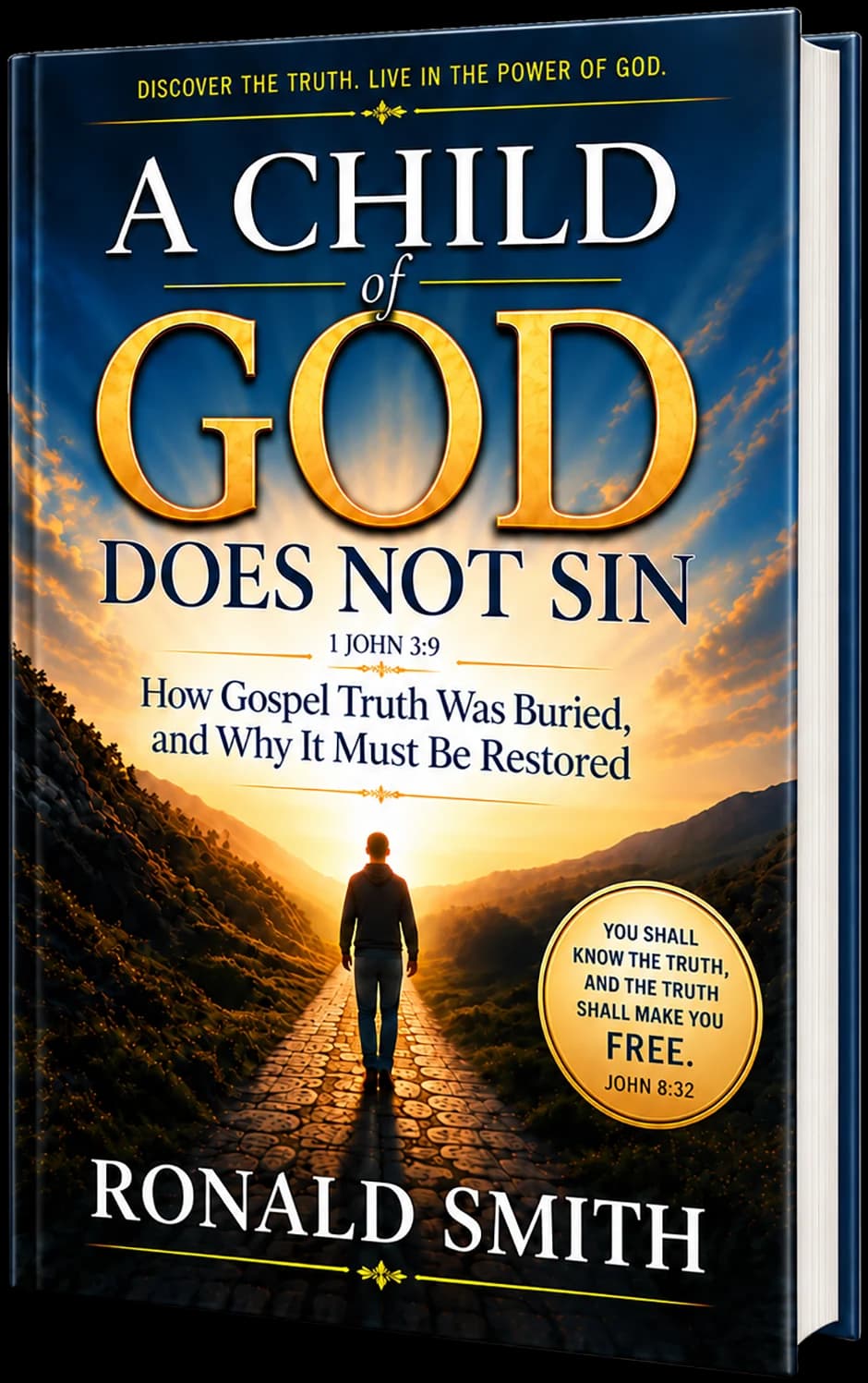
A video from a group called Christian Faith Archive has been getting attention. It lists eight doctrines it says American megachurches have quietly stopped teaching. I'm only going to look at the first two, the reality of hell and the sinfulness of sin, because those are the ones that bear directly on my book, A Child of God Does Not Sin. I'll walk through what the video says, check it against Scripture, and show where John Wesley and my book fit in. I can't verify every detail in a video like this, so I'll stay with the argument, the Bible, and the data I could confirm.
What the video claims
On hell, the video says Jesus described a place of weeping, outer darkness, and a fire that is not quenched, and that preachers like Jonathan Edwards and Charles Spurgeon preached it often. Today, it says, hell often survives only in the fine print of a church's statement of faith. In its words, "The doctrine did not disappear from the statement of faith, it disappeared from the sermon."
On sin, the video says the language has been swapped for something softer. "People are not told they are sinners. They are told they are broken." The gospel then becomes help for loneliness and anxiety, and nobody mentions the deeper problem. Its summary line is a good one: "People who never learn they are sinners never understand why they need a savior."
Is every megachurch like this? Of course not, and many pastors love people and want to reach them. But the pattern the video describes is real enough that it deserves a serious look.
What Jesus said about hell
Whatever you think of the video's statistics, the Bible's side is not hard to check. Jesus spoke of "outer darkness," where "there will be weeping and gnashing of teeth" (Matthew 8:12). He spoke of hell "where their worm does not die and the fire is not quenched" (Mark 9:47-48). And He said that the wicked "will go away into everlasting punishment, but the righteous into eternal life" (Matthew 25:46). The same Greek word describes both the punishment and the life.
Here's a fact worth knowing: the New Testament uses the word Gehenna, which is translated "hell," twelve times. Eleven of those are in the words of Jesus. If anyone should be quoted on this subject, it's Him.
John Wesley agreed it can't be dropped. In his sermon "Of Hell," he wrote, "Every truth which is revealed in the oracles of God is undoubtedly of great importance," and these truths "are repeated over and over" in Scripture. Wesley didn't treat hell as an embarrassing footnote. He treated it as a revealed truth that deserved to be taken seriously.
Where my book comes in: Trap Two
My book describes three traps that keep people from living in freedom from willful sin. Trap Two is not believing the consequences are real. Here's the picture I use in the book. Have you ever robbed a bank? Probably not. You didn't fight the temptation all night. You just don't do it, because you know the rule and you believe the consequence. A known rule plus a believed consequence produces behavior that doesn't require a fight.
Now take hell out of the sermon. The rule may still be on the books, but the consequence has quietly disappeared. In the book I list the kinds of things people hear in its place: "One sin won't send you to hell." "God knows your heart." "You'll always struggle with this, and God understands." Each one, used as comfort when it should have been correction, makes the consequence feel optional.
Evangelist Ray Comfort has made the same point, which I cite in the book. His method begins with God's law, not with God's love, because the law is what breaks through Trap Two. The video is describing what happens when that step gets skipped.
What the surveys do show
The video cites a Lifeway survey on how often pastors preach about hell. I looked for it and couldn't find it, so I won't repeat the number. I also couldn't find any reliable survey that measures how often hell is preached. What I did find is Lifeway Research's 2025 State of Theology survey of American adults, and its results fit the pattern the video describes.
- Most people believe hell exists. 57% of Americans say hell is a real place where certain people will be punished forever. Among evangelical Protestants it's 84%.
- Few believe sin is serious enough to send anyone there. Only 23% agree that "even the smallest sin deserves eternal damnation." Even among evangelical Protestants, only 38% agree.
- Most people think they're basically good. 66% say everyone sins a little but most people are good by nature, and 74% say everyone is born innocent in the eyes of God.
Put those together. People believe hell exists, but they assume it isn't for them. Lifeway's own report says it this way: most Americans have no problem with the idea of hell, "but they might assume those don't apply to most people." That is Trap Two almost word for word: believing the consequences are real in general, and not believing they are real for you.
A survey of what people believe can't prove what pastors did or didn't preach. But it fits. And in its advice to pastors, the same Lifeway report asks: "How often do you mention hell in your sermons?"
What happens when sin becomes "brokenness"
The video quotes Romans 3:23: "for all have sinned and fall short of the glory of God." And Romans 6:23: "the wages of sin is death, but the gift of God is eternal life in Christ Jesus our Lord." And Isaiah 59:2: "your iniquities have separated you from your God."
I want to be careful here, because the word "broken" isn't always wrong. Some people are hurting, wounded, or weak, and those things are real. John Wesley himself taught that not everything is sin. Mistakes, ignorance, weakness, and temptation are not sin in the strict sense. But willful sin is. It is knowing what God commands and choosing otherwise, and it is not a struggle or a mental-health label. It's a choice, and calling it by a gentler name doesn't help the person making it.
Wesley understood why this matters. In his sermon "The Law Established Through Faith," he told preachers, "You are first to convince them that they are sick; otherwise they will not thank you for your labour." And he warned that offering Christ to people who feel no need of Him is "equally absurd." He even warned that preaching only Christ's sufferings and merits, with no law alongside them, would, over time, "make void the gospel as well as the law." That's strong language from a man who preached grace as loudly as anyone in his century.
Why this matters for 1 John 3:9
My book starts with a promise: "Whoever has been born of God does not sin, for His seed remains in him" (1 John 3:9). That promise is wonderful news, but only to someone who knows what sin is and what it costs. If sin has been renamed as "brokenness," freedom from sin sounds unnecessary. If hell has been removed from the picture, nobody feels the urgency to be free.
In the book I put it this way: if you hope to spend eternity with a holy God, why would you expect that eternity to be filled with people who spent their lives cheerfully, casually, routinely disobeying Him? A faith that makes peace with ongoing sin has made peace with staying out of step with the presence of God.
What this isn't
None of this means preaching hell to frighten people or to win an argument. Jesus wept over Jerusalem: "How often I wanted to gather your children together, as a hen gathers her chicks under her wings, but you were not willing!" (Matthew 23:37). He told the truth about judgment because He wanted people to come home. And it is not a claim of sinless perfection. Mistakes, ignorance, temptation, and ordinary human weakness aren't what's in view. What's in view is willful sin, and the good news that a child of God can be free from it.
One question
If the word "sin" and the word "hell" both disappeared from your church's teaching, what would you notice first? If the answer is "nothing," that may be the clearest sign of how much has already gone missing.
A Child of God Does Not Sin is now available on Amazon.
— end —